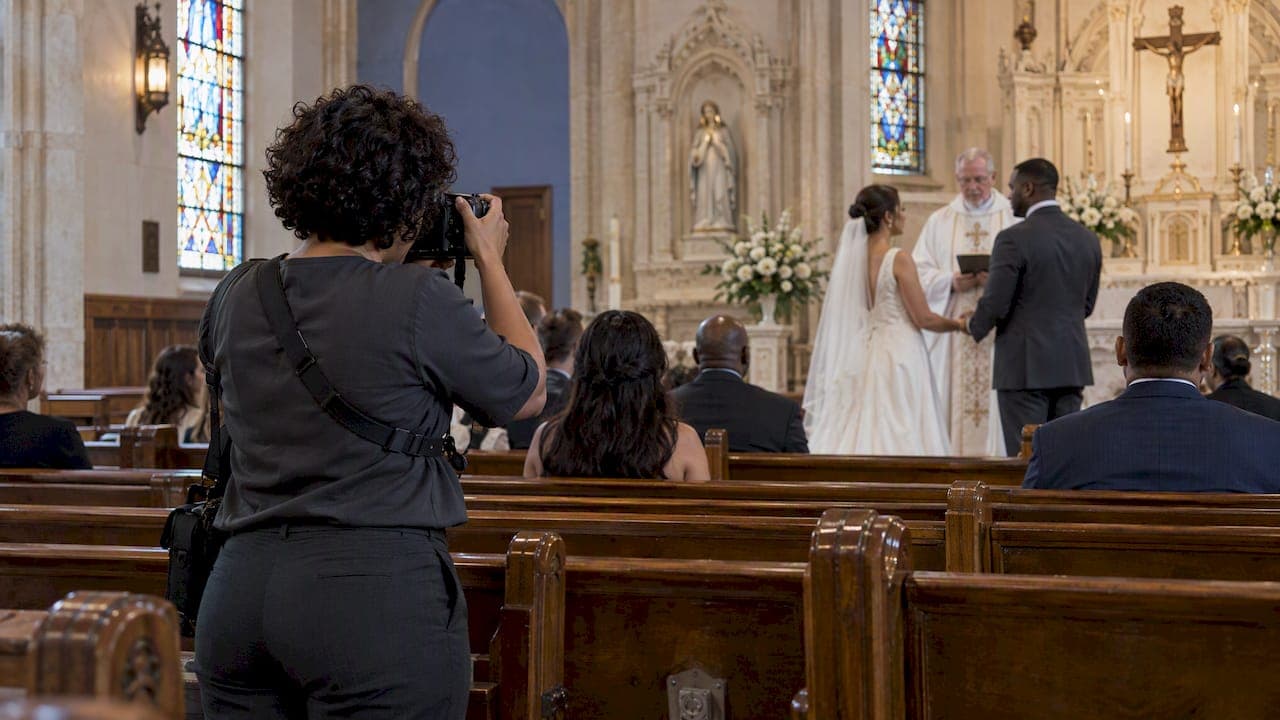
Catholic wedding photo guidelines vary by parish, but they follow a common pattern. There is no flash during the liturgy. Your photographer stays out of the sanctuary and out of the congregation's sightline. Movement is limited, and the time for posed photos inside the church is short. Your parish's own written policy is the final word, and you should have it in hand before you book a photographer.
This guide covers what those policies usually say, why they exist, how they change the way a wedding gets photographed, and how to plan so you still get the pictures you want.
TL;DR
- A Catholic wedding is an act of worship, so photographers are treated as guests of the church and must work quietly and from limited positions.
- Expect no flash during the ceremony, no entry to the sanctuary, and strict limits on moving around.
- Posed photos inside the church usually get a short window, so plan portraits for another location or a separate session.
- Get your parish's written guidelines first, then share them with your photographer and videographer before the wedding.
- Hire someone who has shot Catholic ceremonies and will ask your coordinator questions rather than assume.
Table of Contents
- Why a Catholic ceremony is photographed differently
- What most parishes ask of photographers
- What happens when the rules are broken
- How the guidelines change the shot list
- Planning your timeline around the church
- Who to ask, and what to ask
- Choosing a photographer who knows the drill
- Our perspective
- How we can help
- Frequently asked questions
- Sources
Why a Catholic ceremony is photographed differently
A Catholic wedding is a sacrament, not a staged event. The U.S. bishops' wedding guidance says it is good for the wedding to be simple so that what is truly important stands out, instead of the details like photographs, clothes and flowers. Photos are valuable, but they are secondary to the celebration of the sacrament.
According to the USCCB, a valid Catholic marriage rests on three things: capacity, free consent and canonical form. Canonical form means the vows are exchanged before an authorized priest or deacon and two witnesses. Those moments are the heart of the day, and they are exactly the moments a photographer wants to capture. The guidelines exist so you can have both: a reverent ceremony and a complete record of it.
The church is also a working house of worship. Another Mass, confessions or a second wedding may be scheduled soon after yours. That is why rules about timing are just as firm as rules about flash.
What most parishes ask of photographers
Every parish writes its own policy, and some are stricter than others. Still, the same themes show up again and again. The guidelines at Our Lady of Grace Catholic Church are a good example of a parish-level document, and the Cathedral of St. Patrick publishes a form that every photographer or videographer must review before working a wedding there.
Flash
Flash during the liturgy is the most common prohibition. Some parishes allow it only briefly, for example during the processional and recessional, and not during readings, vows or Communion. Others ban it entirely. If your church is dim, that matters a great deal, and it is the first question to put to your photographer: how do you work in low light without flash?
The sanctuary
The sanctuary is the area around the altar, and photographers are generally not allowed in it. The Archdiocese of Omaha's workbook for couples describes the sanctuary as a holy place consecrated for the worship of God. Plan on your photographer shooting from the nave, the side aisles or another approved spot, not from behind the priest.

Movement and position
Parishes typically limit moving around during the ceremony. Photographers are asked not to block the view of the congregation or the priest, and to stay put for long stretches. Many are told to stay behind the first row of pews. A photographer with a long lens and a calm temperament does far better here than one who relies on being close.
The choir loft
The loft can be a great vantage point, since it gives a view down the aisle without disturbing anyone. It is also shared space. Guidance from the Cathedral of St. Patrick's form says photographers should coordinate with the organist or music director before using it, and the loft is where music takes priority. Ask early, not at the door.
Time limits
Many parishes set limits on when photographers may arrive and how long photos may continue afterward. One common pattern is a short window after the ceremony, often 15 to 30 minutes, because the church has other things on its schedule. Check your own parish's number. Do not assume.
Videography and equipment
Videographers are covered by the same rules and often a few more: where tripods may stand, whether lights are allowed, and whether wireless microphones may be placed on the priest. The Cathedral form above applies to photography and videography alike. If you are hiring both, give each the parish document.
What happens when the rules are broken
Parishes take this seriously. A photographer who enters the sanctuary, moves furniture or causes a distraction can be asked to leave, and that can jeopardize your coverage in the middle of your own ceremony. Coordinators also remember who behaves. A photographer who ignores the rules may not be invited back to that church.
The flip side is good news. Photographers who are reverent and unobtrusive tend to earn more trust from church coordinators, and trust can mean more flexibility. A photographer the parish knows and likes is an asset.
How the guidelines change the shot list
Rules do not make a Catholic wedding harder to photograph well. They change the approach. A typical plan looks like this:
| Moment | Typical approach under parish rules |
|---|---|
| Preparation | Done before arriving at the church, with no restrictions from the parish |
| First look or portraits | Often outdoors, off-site or before the arrival window opens, if the parish allows it |
| Processional | Flash may be allowed here at some parishes, so confirm; otherwise shoot ambient light from a side or rear position |
| Readings, homily, vows | Silent shutter, long lens, no movement, no flash |
| Exchange of rings and kiss | Often shot from the same fixed position; ask if one move is permitted |
| Recessional | Usually the second chance for flash at parishes that allow it |
| Family and wedding party portraits | Short church window, or moved outside, to a park, or to the reception venue |
Notice what this means. Anything you want to look polished and posed should not depend on the church. The ceremony is documentary by nature, and the portraits can happen elsewhere.
Planning your timeline around the church
Time is the real constraint. If your parish allows photos for only a short stretch after the ceremony, and your family list is long, the minutes disappear quickly. Three adjustments help:
- Shrink the in-church list. Choose the formal groupings that matter most, such as immediate family and the wedding party, and move the rest to the reception or another site.
- Add buffer. A 15 minute cushion between ceremony end and the next event absorbs the slow exit, the hugs and the late grandmother. Our post on a 15 minute buffer in the wedding timeline explains how.
- Work backward from the ceremony. Our wedding photography timeline guide walks through how to build the day around fixed points like a church start time.
If you are still choosing a ceremony time, our article on booking your photographer with timelines in mind may help you set it.
Consider a separate bridal or couple session
If you want portraits in your church's beautiful interior, the wedding day may not be the place. Some parishes will arrange a separate time. Ask your coordinator whether it is possible, and what the rules are on that day. An engagement session is another good way to get relaxed, unhurried photos, and it also lets you and your photographer get comfortable together before the wedding.
Who to ask, and what to ask
Start with your parish wedding coordinator or priest. The St. James Catholic Church guidelines, for example, ask couples to consult with the wedding coordinator when planning, and say this consultation should happen at least two months before the wedding and before any other vendor plans are made. Your own parish may set a different timeline, so ask early.
Bring these questions:
- Is there a written photography and videography policy? Can we have a copy?
- Is flash permitted at any point in the ceremony?
- Where may the photographer and videographer stand, and are any positions off-limits?
- Can the choir loft be used, and who approves it?
- When may photographers arrive, and how long may photos continue after the ceremony?
- Are photos with the priest allowed, and when?
- Do vendors need to sign anything or pay a fee?
Then pass the answers to your vendors in writing. A photographer who reads your parish's policy before the day is a photographer the church will welcome.
Choosing a photographer who knows the drill
When interviewing photographers, ask about Catholic ceremonies specifically. Have they photographed at your parish or similar ones? How do they shoot without flash? Where will they stand during the vows? Do they bring a second shooter, and will that person follow the same rules?
Our list of questions to ask wedding photographers before you book covers the general interview. Add the church questions above to it. If you want to understand how professionals think about conduct at ceremonies, see our explainer on wedding photography ethics.
Our perspective
We photograph weddings in and around San Antonio, and our approach blends editorial and documentary styles. That blend suits a Catholic ceremony well. The ceremony itself calls for the documentary side: watching, anticipating, and staying out of the way. The editorial side comes in afterward, in the portraits, the details and the quieter moments around the day.

We treat a church as the parish's space, not ours. In practice that means we read the guidelines before the wedding, ask the coordinator when something is unclear, and plan our positions in advance instead of improvising. We would rather give up a frame than interrupt a prayer.
Our advice to couples is simple. Do not fight the rules, plan around them. Put the formal portraits where the light and time are good, and let the ceremony be the ceremony. The pictures from the vows are better when the people in them are focused on each other, and a photographer who is calm and invisible helps that happen.
— Todd
How we can help
If you are planning a Catholic wedding in San Antonio, New Braunfels or elsewhere in Texas, we can talk through your parish's policy, your timeline and where portraits will work best. See our wedding photography and videography pages, or get in touch through our San Antonio wedding photographer page to check your date.
Frequently asked questions
Can a photographer use flash at a Catholic wedding?
It depends on the parish. Many forbid flash during the liturgy and allow it only briefly, such as during the processional and recessional, if at all. Ask your coordinator for the exact rule, and ask your photographer how they handle dim churches without it.
Can photographers go up to the altar?
Generally no. The sanctuary is the area around the altar, and standard guidelines forbid photographers from entering it. Your photographer will usually work from the nave, a side aisle or an approved loft, so choose someone who is comfortable shooting from a distance.
How long do we have for photos in the church after the ceremony?
Many parishes limit post-ceremony photos to a short window, often 15 to 30 minutes, because other services or events follow. Your parish sets its own limit. Plan to take the majority of portraits elsewhere.
Do the same rules apply to the videographer?
Yes, and often more. Policies such as the Cathedral of St. Patrick's guidelines cover both photography and videography. Give your videographer the parish document just as you do your photographer, and confirm where tripods and any audio equipment may go.
Who has the final say on photography rules?
Your parish does. The priest and the wedding coordinator decide what is allowed at your church, and their written policy overrides any general advice, including this article.
Sources
- Wedding Ceremony, USCCB
- Convalidation: Bringing Your Marriage Into The Church, For Your Marriage
- Guidelines for Wedding Photographers, Our Lady of Grace Catholic Church
- Photography / Videography Guidelines, Cathedral of St. Patrick
- Celebration of Matrimony Workbook, Archdiocese of Omaha
- Wedding guidelines, St. James Catholic Church