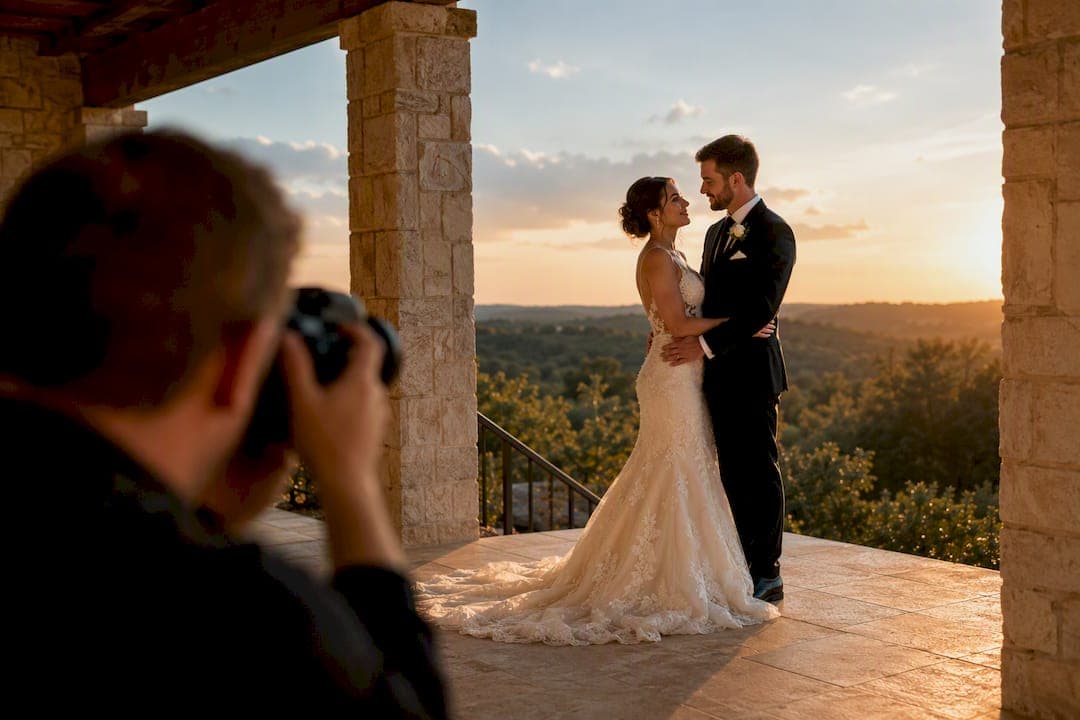
The best way to lock in your wedding photography is to build the day around a photographer-led timeline, starting with a copy-paste template, not a blank schedule. Add buffers at every transition, apply the "Ready By" rule so hair and makeup finish on time instead of starting late, and treat golden hour as fixed, not flexible. Pick a template below, then start detailed timeline work with your photographer or planner 60 to 90 days before the wedding.
TL;DR:
- A well-structured wedding photography timeline relies on a detailed template built 60 to 90 days in advance, with buffers at every transition point.
- Allocating 45 to 60 minutes for couple portraits, 30 minutes for family formals, and protecting golden hour are critical for capturing key shots without schedule stress.
- Implementing the "Ready By" rule ensures hair and makeup finish on time, preventing cascade delays for subsequent photography and ceremony parts.
- A single owner, either the planner or photographer, should manage the timeline during the day to keep everything on track and coordinate with videographers.
- Booking your photographer early and finalizing the detailed schedule at least two weeks before the wedding ensures vendor availability and smooth execution.
Table of Contents
- Copy-Paste Wedding Photography Timeline Templates
- How Long Do Portraits Really Take?
- Should You Do a First Look?
- The "Ready By" Rule and Buffer Defaults That Actually Work
- Who Owns the Timeline on the Wedding Day?
- When Should You Book Your Photographer and Finalize the Timeline?
- Turning a Template Into Your Actual Wedding-Day Timeline
- Todd's Take on Building a Timeline That Survives the Day
- Get Your Timeline Built by Someone Who Books It for a Living
- Sources
- FAQ
Copy-Paste Wedding Photography Timeline Templates
Every wedding timeline gets built backward from two fixed points: the ceremony start and sunset. Everything else gets slotted around those anchors.
Template A: 8-hour coverage with a first look
- Photographer arrival, detail shots (rings, dress, invitations): 30 minutes
- Getting ready coverage: about an hour
- First look: about 20 to 30 minutes
- Wedding party and couple portraits: about an hour
- Family formals: 30 minutes
- Ceremony: about 30 to 45 minutes
- Cocktail hour (couple mingles or sneaks off for golden-hour shots): about an hour
- Reception, toasts, first dances, golden-hour portraits worked in near sunset
Template B: 8-hour coverage without a first look
Getting ready runs the same, but portraits and family formals shift entirely to after the ceremony, compressed into cocktail hour. This works for earlier ceremony start times but gets tight if your ceremony starts after 4 p.m., since you're racing sunset for portraits and cocktail hour at the same time.
If your coverage window is shorter than eight hours, cut from cocktail hour first, not from family formals or the ceremony itself. If it's longer, that extra time almost always belongs in getting-ready coverage or an added second location for portraits.
How Long Do Portraits Really Take?
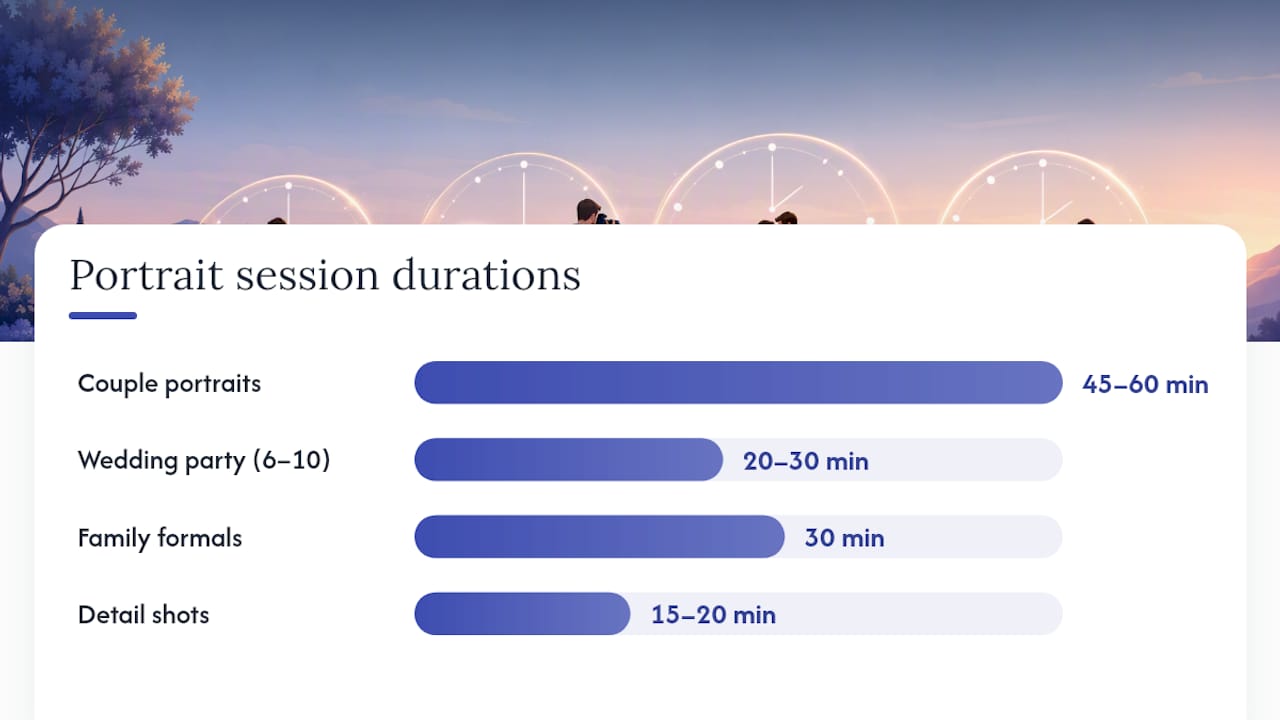
Photographer-sourced templates put couple portraits at 45 to 60 minutes and family formals around 30 minutes, assuming a tight guest list. Those numbers hold up across most venues, but they only work if you've prepared a shot list in advance.
- Couple portraits: 45 to 60 minutes, more if you're moving between two backdrops
- Wedding party portraits: about 20 to 30 minutes for a party of six to ten
- Family formals: 30 minutes, using a strict grouping order
- Detail shots (rings, invitations, shoes, bouquet): about 15 to 20 minutes, usually done while others are still dressing
The rule that keeps family formals from blowing up your schedule is simple: budget about three minutes per group. A list of ten groupings runs about 30 minutes, which is exactly why narrowing the family list to immediate family matters more than any other single decision in the day.
Assign one person, usually a sibling or the planner, as the wrangler whose only job is pulling the next group into place before the current one finishes. Print the shot list and hand it to that person, not to your photographer, who needs to stay behind the camera.
Pro Tip: Pre-collect your family formals list a week before the wedding and text it to your wrangler, so nobody is hunting for Uncle Ray during a 30-minute window that's already tight.
Should You Do a First Look?
A first look is not a style preference. It's a time-management decision that reshapes your entire afternoon.
- Skipping it means all portraits happen post-ceremony, compressed into cocktail hour, which often means you miss part of your own cocktail hour
- Doing one moves couple portraits and part of the wedding party shots earlier, freeing up more of the reception for you to actually attend
- A first look strongly favors couples with short coverage windows, multiple photo locations, or an early sunset relative to their ceremony time
If your ceremony starts at 5 p.m. and sunset hits at 6:30, skip the debate: you need a first look or you're not getting outdoor portraits at all. Read more on what a first look actually changes about your specific schedule before deciding.
The "Ready By" Rule and Buffer Defaults That Actually Work
The "Ready By" rule states hair and makeup should be finishing, not starting, at the moment photography coverage begins. Miss that, and every block after it slides later, usually without anyone noticing until the ceremony is already 20 minutes behind.
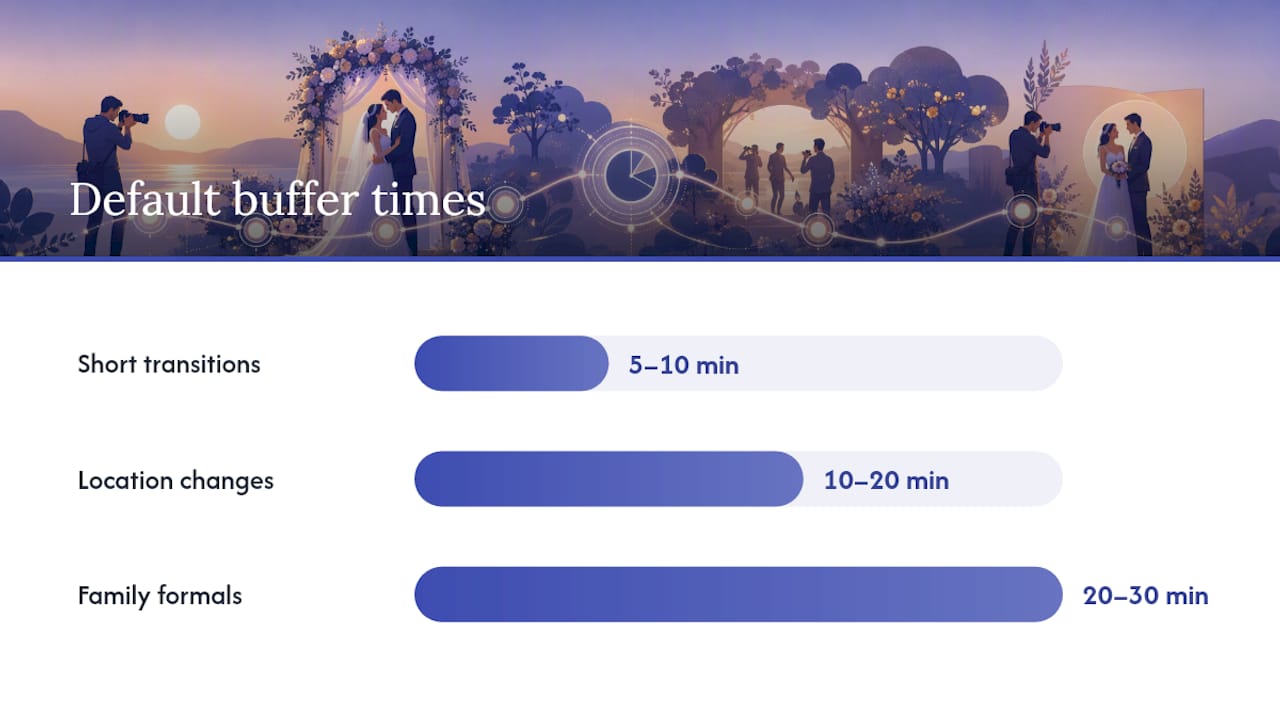
Photographers build in buffers everywhere because timelines rarely survive contact with a real wedding day:
- Transitions between locations or activities: 5 to 10 minutes
- Full location changes (venue to portrait site): 10 to 20 minutes
- Family formals, if the list is tight: 20 to 30 minutes
Buffer defaults like these exist because three points in the day tend to break first: the ceremony start, the family formals block, and the toasts and first dances. Protect those three specifically. If you fall behind anywhere else, cut cocktail hour time before you touch any of those three.
Who Owns the Timeline on the Wedding Day?
One person should own the timeline, full stop. That's usually the planner if you have one, or the photographer if you don't.
- The owner tracks time against the schedule and calls the shots when something runs long
- Wranglers get a printed list and one job each: gather people, not manage timing
- Second shooters and videographers need the same shot list as the photographer to avoid duplicating angles or blocking each other during formals
Coordinating early with a videographer's own workflow prevents the two most common on-site conflicts: crossed sightliness during the ceremony and competing directions during formals.
When Should You Book Your Photographer and Finalize the Timeline?
Book your photographer well in advance for peak wedding season, or several months ahead for off-peak dates. Popular photographers get reserved early, and some couples book a favorite photographer before finalizing their venue date.
- Start detailed timeline conversations a couple of months before the wedding and finalize the timeline at least a couple of weeks before, so vendors have time to adjust
- Ask any photographer you're vetting whether they build the timeline with you or expect you to bring one
Turning a Template Into Your Actual Wedding-Day Timeline
- Confirm your must-have shot list with your photographer and cut it ruthlessly
- Assign a wrangler for family formals and brief them a week ahead
- Add buffer minutes at every transition and location change
- Confirm actual travel times between venues, not estimated ones
- Circulate the final timeline to your venue, planner, and wedding party
A short text to your bridal party works better than a printed schedule nobody reads: "Hair/makeup done by 12:30, photos start 1:00 sharp, ceremony 4:00. Please be ready early, not on time." Add your essential shot checklist as a reference for anyone helping wrangle the day.
Todd's Take on Building a Timeline That Survives the Day
Every timeline meeting starts with the same question: what three moments matter most if everything else runs late? That answer decides where the buffers go. Golden hour gets protected first, always, and the "Ready By" line gets enforced without exception, because a late start at 11 a.m. is a late ceremony by 4 p.m.
— Todd
Get Your Timeline Built by Someone Who Books It for a Living
Timeline details can be incorporated directly into wedding packages, including shot-list preparation, wrangler recommendations, and second-shooter coordination when needed.
Browse real wedding-day schedules and finished galleries on the Clients page, or look at how portrait timing plays out in an engagement session before your wedding day arrives. If you're 60 to 90 days out and need your timeline finalized, reach out now to get it on paper before the two-week deadline sneaks up on you.
Sources
Templates and rules above draw from WeddingWire, Brides, Photo-Logica, Staci Addison Photography, and Samantha Brady Creative.
- The Ultimate Wedding Photography Timeline
- The Ultimate Wedding Photography Timeline for Your Big Day
- Wedding Photography Timeline Template (Schedules + Buffers)
- When Should We Book Our Wedding Photographer?
FAQ
How far in advance should I book a wedding photographer?
Book 9 to 18 months ahead for peak season dates (spring and fall), or 6 to 12 months ahead for off-peak dates, since popular photographers fill their calendars early.
What is a good timeline for wedding photography?
An 8-hour timeline with a first look typically allots 45 to 60 minutes for couple portraits, 30 minutes for family formals, and a protected window near sunset for golden-hour shots, with buffers of 5 to 10 minutes between transitions.
What is the 30-5 rule for weddings?
Definitions vary by photographer and there's no single agreed-upon standard for this rule. What's better documented is the "Ready By" rule: hair and makeup should be finishing, not starting, when your photographer's coverage window begins.
What is the typical timeline for booking a wedding videographer?
Videographers generally follow the same booking window as photographers, 9 to 18 months out for peak dates, and their shot list should be coordinated with the photographer's timeline to avoid duplicated angles during the ceremony and formals.
When should we finalize the wedding photography timeline?
Start detailed planning 60 to 90 days before the wedding and finalize the schedule at least two weeks out, giving your venue, planner, and vendors time to adjust.