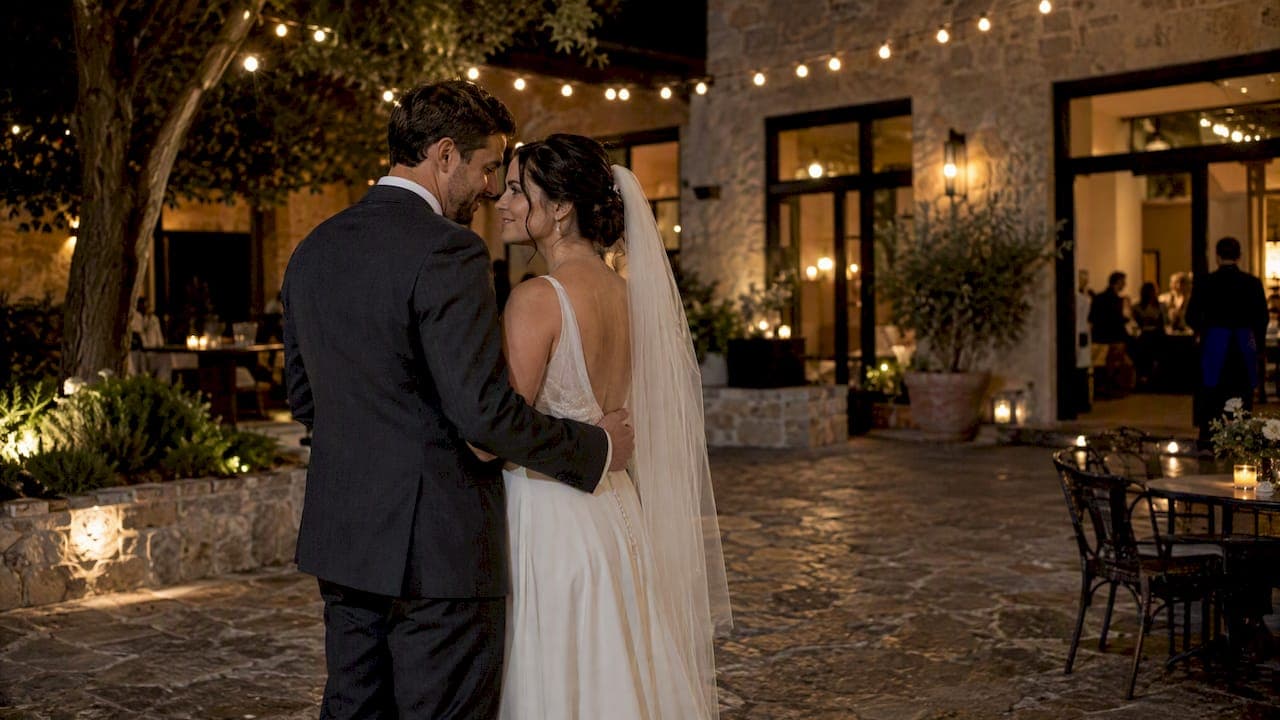
Yes, you can get beautiful night wedding photos, and they are often the most dramatic images in the gallery. The difference between glowing and muddy comes down to three things: a photographer who is skilled with flash and low light, a short window set aside on the timeline, and a venue with a few good light sources. This guide covers all three, with the questions to ask before you book.
TL;DR
- Night portraits need artificial light. Ask any photographer you're considering to show real reception and after-dark galleries, not just daylight work.
- Block 15 to 30 minutes for a dedicated night session. Rushing it is the main reason night photos disappoint.
- Start at blue hour, the deep-blue stretch right after sunset, then move to flash-lit portraits as the sky goes dark.
- Group formals and family photos should happen before dark whenever the schedule allows.
- Confirm your photographer's lighting gear and backup plan in writing, including for venues with LED or colored lighting.
Table of Contents
- Can you take wedding photos at night?
- Night, twilight and blue hour: what each one means
- Build the timeline around the dark
- Lighting that makes night photos work
- Seven night photo ideas worth planning
- What to wear and what color looks best
- What San Antonio couples should consider
- Our perspective
- How to choose a photographer for a night wedding
- Planning night photos with Larson Pro
- FAQ
- Sources
Can you take wedding photos at night?
You can, but not the way you would at 5 p.m. Without sunlight, every flattering light source is one your photographer brings or finds. That means off-camera flash, continuous LED panels, or the venue's own string lights, candles and signage.
The technique that makes night images feel natural is often called dragging the shutter: a slower shutter lets the ambient glow of the room reach the sensor, while the flash freezes your faces. The result is a sharp couple in front of a background that still has color and depth, instead of a black void.

A photographer who works only with natural light will struggle after dark. That is not a flaw in the person, it is a different skill set. Treat it as a hiring question, not an afterthought.
Night, twilight and blue hour: what each one means
These terms get used loosely, so here is how we use them when planning a timeline.
| Window | What it looks like | Best for |
|---|---|---|
| Golden hour | Warm, low sun before sunset | Soft, glowing outdoor portraits |
| Sunset | Orange and pink sky, strong color | Dramatic silhouettes and wide scenes |
| Blue hour / twilight | Deep blue sky, cool tones, a little detail left in the landscape | Moody portraits with a visible sky |
| Full night | Dark sky, lit only by artificial sources | Flash portraits, sparklers, reception energy |
Blue hour is the cool, moodier counterpart to golden hour, and it is the sweet spot for couples who want night-style images without losing the sky. Twilight is the same idea: those minutes when the sun is gone but the sky still holds color.
That window is short. In the October 2026 sun table for San Antonio, civil twilight ends roughly 20 minutes after sunset on a mid-month date. Look up your own wedding date and plan to be outside, ready, before the sun drops, not after.
If golden hour is also on your wish list, our guide on how to protect a 10 to 20 minute golden hour in San Antonio shows how to build the schedule so both light windows fit.
Build the timeline around the dark
Most night photo problems are timeline problems. A few rules we follow:
- Do family formals and wedding party photos before dark. Large groups are the hardest thing to light well at night and take the longest. One planner-style tip echoed across wedding forums is to expect formals to take more time when light is limited.
- Schedule a separate couple session. Pull the two of you away for 15 to 30 minutes, ideally right as blue hour begins. You get portraits and a short break from the party.
- Protect a buffer. Add 10 minutes for walking, touching up and setting up lights. Photographers need that time to place flash and test exposure.
- Pick a spot before the day. Know exactly where you will go: a lit courtyard, a street with warm bulbs, the edge of a patio with the venue behind you.
- Ask your DJ or coordinator to hold the next event. Announcements for toasts or cake can eat your session if nobody is guarding it.
For evening ceremonies, the same logic applies, only compressed. If the ceremony ends after sunset, the couple portraits may happen entirely in artificial light, and your photographer should say so in advance.
Lighting that makes night photos work
You do not need to understand the gear, but it helps to know what good looks like.
Backlight and rim light
The most flattering night portraits usually place a light source behind or beside the couple. Backlighting separates you from the background and gives a glowing edge to hair and veil. As one widely read tutorial on wedding photography at night puts it, you will almost always want to backlight the frame and the couple, but the principle is simple enough to ask about: where will the light sit, and what is behind us?
Off-camera flash
A flash on the camera flattens faces and creates harsh shadows. Off-camera flash, placed on a stand or even rested on the ground, gives shape. Modern photographers also use it to light reception details such as centerpieces and signage, which is covered well in this walk-through of reception detail photography at night.

For a look at how a working photographer organizes a lighting day, our post on a wedding lighting setup workflow is written for photographers but shows what a prepared pro does.
Sparklers, string lights and candles
These give you the glow without much equipment. Sparklers work best when the sparkler line is short, the crowd is organized and the photographer has the couple lit with a soft flash so faces are not just silhouettes. Ask your venue first: many ban open flame, and some outdoor spaces restrict sparklers during dry weather.
Venue lighting surprises
Some modern venues use pulsing LED or color-changing lights. These can cause visible stripes in photos from cameras using an electronic shutter, a problem photographers discuss openly. Experienced shooters test for it during setup and switch to a mechanical shutter when needed. It is a fair thing to ask: how do you handle tricky LED lighting?
Seven night photo ideas worth planning
- The blue hour portrait. Couple in front of a softly lit building or tree line, with a dark-blue sky above.
- The sparkler exit. Two lines of guests, the couple running through, lit by a quiet flash.
- The dance floor drag. A slow shutter with flash so the dancing blurs into light while the couple stays crisp.
- The getaway car. Headlights, taillights and a glowing sign make a strong frame. If a classic car or chauffeured ride is part of your plan, these safe getaway car decorating tips will keep paint and windows intact.
- The rooftop or patio skyline. City lights bokeh behind the couple.
- The quiet moment. A step away from the reception, a hand on a shoulder, a candle or string-light glow.
- Late-night details. Leftover cake, shoes under a table, a crowded dance floor at the last song. These images tell the end-of-night story that daylight galleries miss.
If your day includes an indoor reception, our 20 indoor wedding photo ideas with a shot list will help you build a plan that works whether the night is outdoors or in.
What to wear and what color looks best
Color questions come up a lot. A few practical points:
- Ivory and white reflect flash well and glow against dark backdrops. Very bright pure white can overexpose, so a warm ivory is often easier.
- Deep tones such as navy, black, burgundy and forest green look rich against string lights and candles.
- Metallics and sequins catch light beautifully, but mirror-like fabrics can bounce flash in odd ways. Ask your photographer to test.
- Skip pale tones with heavy patterns for the portrait session, since fine textures can look noisy in low light.
Whatever you choose, bring it to the engagement session if you can, so your photographer sees how it reacts to flash. Our engagement photography in San Antonio is a good way to rehearse before the wedding day.
What San Antonio couples should consider
Local venues vary a lot. Hill Country barns may be very dark beyond the dance floor, while downtown spaces and River Walk spots bring city light and reflections. Texas heat and humidity also matter in the evening, since fog on lenses and sweaty skin under flash are real issues in warm months. Plan time for a quick touch-up before the portrait session.

If you are scouting spots, our list of photographer-tested bridal portrait locations in San Antonio is a good starting point. Some of them look as good after dark as they do in the afternoon, particularly places with warm, built-in lighting. Walk them at the hour you will actually shoot, not at noon.
For outdoor locations beyond the city, see our outdoor wedding photography ideas.
Our perspective
We like night photos best when they feel like a continuation of the day, not a separate staged event. Our approach blends editorial portraits with documentary coverage, so we look for a short, deliberate window to make a few strong couple images, then return to documenting the party as it happens.
What we tell couples most often is this: the photographs improve when you give us time and a plan. Fifteen minutes with a clear location beats an hour of wandering. We would rather skip a pose than rush it, and we would rather you enjoy the dance floor than stand in the dark waiting for a perfect frame.
We also encourage couples to be honest about their venue. If it is dim, loud with LEDs or tightly scheduled, tell us early. That lets us pack the right lights, test the room and build a backup. Reception moments cannot be restaged, which is why our four-step reception photography approach is built around protecting the ones that matter.
— Todd
How to choose a photographer for a night wedding
Ask these questions, and expect specific answers:
- Can I see a full gallery from an evening or night wedding, not just highlights?
- Which lights do you bring, and do you use off-camera flash?
- What is your backup if a flash fails or the venue lighting is difficult?
- How much time do you need for a night portrait session?
- How many photographers will cover the event, and until what time?
- Do you offer video, and does it also handle low light well?
Budget matters too. The Knot reports an average US wedding photographer cost of about $3,000 as of 2025, with the Southwest averaging $2,600. Prices shift with coverage hours, the number of photographers and travel. Later end times for evening coverage may affect your package, so ask how hours are counted.
Our guide to choosing a San Antonio wedding photographer goes deeper on portfolios, contracts and fit, and our wedding planning guides cover the timeline in more detail.
Planning night photos with Larson Pro
If your reception runs past sunset, we will help you build the timeline, scout the lighting and set aside a short portrait window. See our wedding photography details, add wedding videography in San Antonio if you want the dance floor and exit in motion, or get in touch through our site to check your date.
FAQ
Which color looks best at a night wedding?
Warm ivory, champagne and deep jewel tones such as navy or burgundy photograph well under flash and string lights. Very bright pure white can overexpose, and mirror-like fabrics can reflect light unpredictably. Test your outfit at an engagement session if you can.
Are sunset wedding photos worth it?
For most couples, yes. Sunset and blue hour give the richest sky color and the most flattering light of the evening, and the session only needs 15 to 30 minutes. Because the window is short, plan the timeline so you are already outside before the sun sets.
Will night wedding photos turn out bad?
Not with the right photographer. Good night images depend on flash, a reliable low-light technique and enough time. Poor results usually come from a rushed schedule or a photographer who relies only on natural light, so review real evening galleries before you book.
Is $4,000 a lot for a wedding photographer?
It is above the national average. The Knot reports about $3,000 nationally and $2,600 in the Southwest as of 2025. Price depends on hours, second shooters and deliverables, so compare what is included, not just the total.
Sources
- Flash photography: what it is and how to use it, Adobe
- What is blue hour photography, The Knot
- Sunrise and sunset times in San Antonio, October 2026, timeanddate
- Reception detail photography at night, Breathe Your Passion
- Shutter banding discussion, Adobe Community
- After Dark: 50 Gorgeous Nighttime Wedding Photos, Bridal Guide
- The average wedding photographer cost, The Knot