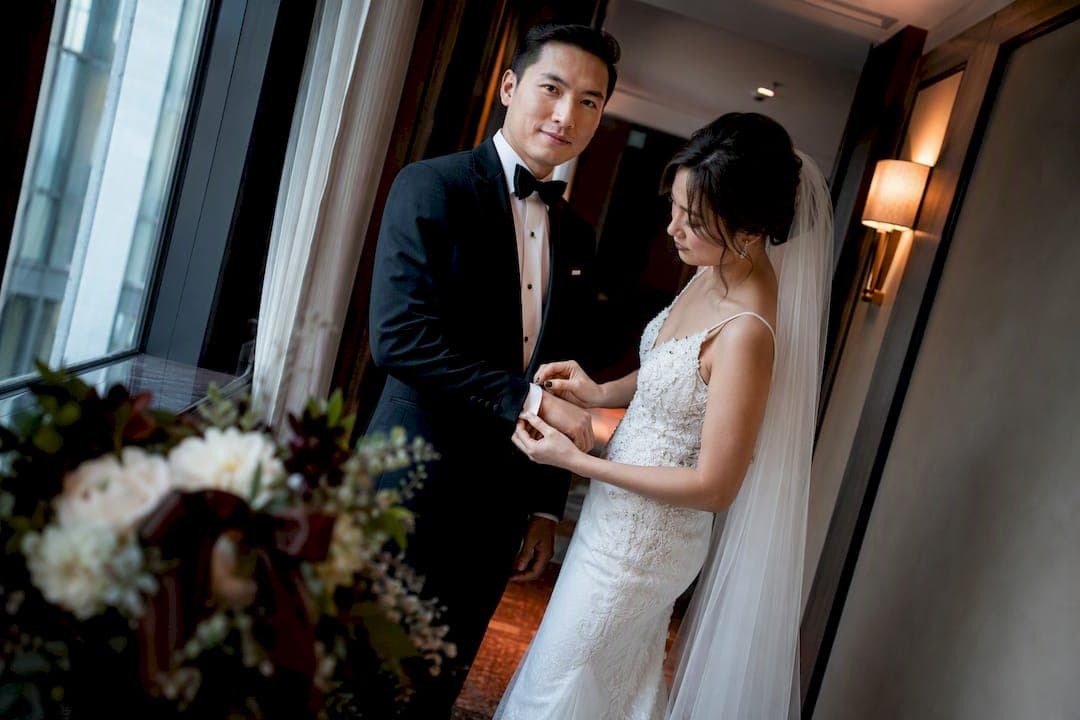
Indoor weddings don't limit your photos, they focus them. Skip the fear that you need a sunset field to get magazine-worthy shots. Window light, staircases, candid ceremony reactions, and string-lit reception portraits all deliver images that feel intimate and deliberate. Below you'll find a full idea bank plus the lighting, posing, and timeline advice to actually pull it off.
TL;DR:
- Natural window light is essential for flattering portraits, especially when timed during late morning or early afternoon for optimal softness.
- Architectural features like staircases, archways, and textured walls enhance background depth and scale without additional staging.
- In dim reception settings, using bounce flash, diffusers, and prime lenses with wide apertures helps maintain image quality without additional lighting gear.
- Prioritizing a short, focused shot list for key moments ensures a complete gallery within limited time, with options to extend if lighting permits.
- Coordinating with venue staff on lighting and layout minimizes surprises and maximizes the potential for intimate, well-lit indoor photos.
Table of Contents
- 20 Indoor Wedding Photo Ideas Worth Stealing
- Lighting and Gear for Indoor Wedding Photo Settings
- Poses That Look Natural in Small Indoor Spaces
- Using Venue Architecture as a Built-In Backdrop
- Reception and Night Shots That Don't Require Stepping Outside
- A Simple Indoor Wedding Photo Timeline
- How Larson Pro Photography Executes These Shots
- Ready to Photograph Your Indoor Wedding?
- Why Indoor Weddings Deserve Better Than "Plan B" Energy
- Sources
- FAQ
20 Indoor Wedding Photo Ideas Worth Stealing
A good indoor shot list mixes portraits, details, and candids so the gallery doesn't feel like one long posed sequence. Here's a working bank to hand your photographer or planner:
- Window-lit bridal portrait: position the bride sideways to a large window for soft, directional light on her face.
- Groom near a window: same trick, different subject. Works especially well in a suite with sheer curtains.
- Indoor first look: stage it in a hallway or suite so you control light and privacy at once.
- Staircase full-length portrait: the classic architectural shot, works in nearly any venue with a grand staircase.
- Veil motion on stairs: have someone toss the veil or catch a breeze from an open door for movement.
- Aisle reaction shots: shoot from behind the guests toward the couple, catching faces mid-emotion.
- Wide altar shot before guests arrive: an empty, dressed ceremony space says a lot about scale and design.
- Getting-ready detail shots: rings, invitation suite, shoes, and dress on a hanger near a window.
- Cufflink close-up: shot in natural light, adds texture to the groom's prep sequence.
- Bouquet-on-table detail: styled against a neutral surface with soft window backlight.
- Candid toasts: capture the speaker and the couple's reaction in the same frame if possible.
- First dance with string-light bokeh: shoot wide open to blur the lights into soft circles behind the couple.
- Sparkler exit: works indoors under a covered breezeway or open door.
- Silhouette in a doorway: backlight the couple against a bright exit or window.
- Reflection in a mirror or polished floor: doubles the visual interest in a single frame.
- Bar-area night portrait: moody, ambient, and usually underused.
- Hallway walking shot: leading lines plus movement equals a natural, unposed feel.
- Overhead detail shot of the reception table: works if the venue has a mezzanine or balcony.
- Guest candid during dinner: laughter, toasts, kids sneaking cake, unscripted life at the tables.
- Grand entrance shot: framed through double doors or an archway as the couple enters the reception.
If a room is too dim for any of these, don't force it. Bring in a small flash, or reserve ten minutes near a bright window or covered outdoor entry as backup.
Lighting and Gear for Indoor Wedding Photo Settings
Large windows are the single easiest light source a venue offers, and scheduling portraits around them matters more than almost any other decision you'll make. Late morning through early afternoon window light tends to be softer and more flattering than direct midday sun, so choosing suites and locations with big windows and timing portraits to use it pays off before a single frame is shot.
Bounce flash and diffusers matter for everything window light can't reach. A photographer bouncing flash off a ceiling or wall fills in shadows without blasting the room with harsh direct light, which keeps the ambience of a candlelit reception intact instead of flattening it.
Pro Tip: Ask your photographer whether they carry a diffuser dome or bounce card. It's a small accessory that makes a huge difference in rooms with low ceilings or colored walls.
Camera settings shift with the room, but useful starting ranges include:
- Aperture around f/1.8 to f/2.8 for portraits, wider for low light and background blur
- Shutter speed at 1/125 or faster to freeze motion during dancing or walking shots
- ISO adjusted according to venue lighting conditions
For very dim receptions, recommended settings widen further, with apertures down to f/1.4, shutter speeds still at or above 1/125 for portraits, and ISO climbing as high as 6400 when the room demands it. Prime lenses in the 35mm, 50mm, and 85mm range tend to outperform zooms indoors because their wider apertures let in more light without sacrificing sharpness.
Coordinate with the DJ or lighting tech ahead of time. Reserving a warm white key light for the first dance, rather than letting colored uplighting dominate, gives skin tones a fighting chance in photos.
Poses That Look Natural in Small Indoor Spaces
Stiff, formal posing reads as staged in tight indoor rooms where there's nowhere to hide the "photo shoot" feeling. Prompts that trigger real reactions work better than instructions to "look natural," which almost nobody can do on command.
- Whisper a memory: ask one partner to tell the other something funny from their relationship, then shoot the reaction.
- Slow dance walk: have the couple walk toward the camera holding hands, then stop and turn into each other.
- Forehead touch: a quiet, intimate pose that photographs beautifully near a window.
- Laugh, then look away: breaks the "posed smile" look almost instantly.
- Hand hold down a hallway: leading lines plus motion, easy to direct, hard to overuse.
Compositionally, frame-within-a-frame shots using doorways or archways add depth in a room with limited space. Foreground blur, shooting through a floral arrangement or a curtain edge, gives images a layered, editorial feel. Negative space against a plain wall or ceiling lets emotion carry the frame instead of clutter.
Get formal shots first while everyone's fresh, then loosen up with candid prompts. Both take only minutes once the couple knows what's coming.
Using Venue Architecture as a Built-In Backdrop
Grand staircases, tall windows, stone archways, vaulted ceilings, and textured brick or wood walls all photograph better than a plain banquet-hall backdrop. Architectural features like these give images leading lines and a sense of scale that a flat wall can't match.
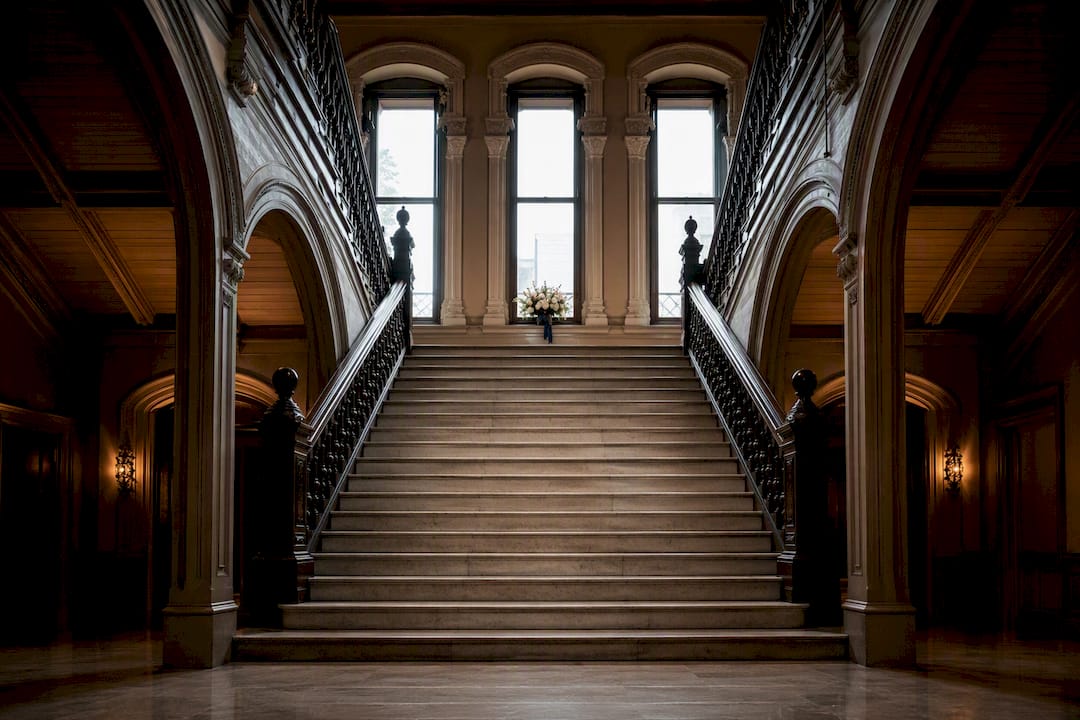
What kills an otherwise great backdrop: clutter in the frame, mismatched fixture colors (warm bulbs next to cool LED strips), and reflective exit signs or AV screens sneaking into the shot. A quick scan of the background before shooting saves an edit headache later.
Staging doesn't need to be elaborate. Moving one chair, clearing a small patch of floor, or setting a single bouquet on a windowsill can add enough depth to turn a flat corner into a usable frame.
Reception and Night Shots That Don't Require Stepping Outside
Evening reception photos can be some of the most cinematic in the whole gallery, and none of it requires leaving the building.
- String lights and fairy lights, shot with a wide-open aperture, turn into soft bokeh circles behind the couple for romantic portraits.
- A bright doorway or window behind the couple creates a clean silhouette with almost no extra gear.
- Sparkler exits work indoors under covered breezeways. Time the shot for when the sparklers are fully lit, not just starting, and check the venue's fire policy first.
- On the dance floor, pair a slower shutter for motion blur in one shot with flash-frozen candids in the next. Ambient light techniques like these give couples both the energy and the sharp detail shots in the same set.
A Simple Indoor Wedding Photo Timeline
A tight schedule doesn't have to mean a thin gallery. It means prioritizing.
- First look: 15 to 20 minutes, ideally near your best window light.
- Family portraits: 15 to 25 minutes, group size dependent.
- Couple portraits: 20 to 30 minutes, spread across two or three locations in the venue.
- Reception portraits: 5 to 10 minutes, grabbed during cocktail hour or a quiet reception moment.
If time runs short, protect five shots first: first look reaction, family formal, one full-length couple portrait, the ceremony kiss, and the reception entrance. Everything else is a bonus. A short, prioritized shot list reduces stress far more than trying to capture everything on the original plan.
Plan B for dim venues: bring a small on-camera flash, hold ten minutes for a quick golden-hour step outside if the venue allows it, or shift group shots to the cocktail area where lighting tends to be better than the main ballroom.
How Larson Pro Photography Executes These Shots
A window-lit getting-ready portrait, a staircase full-length shot, and a string-light reception portrait show up in nearly every indoor wedding gallery Larson Pro Photography shoots in and around San Antonio. Each one comes from the same habit: scouting the room before the day starts.
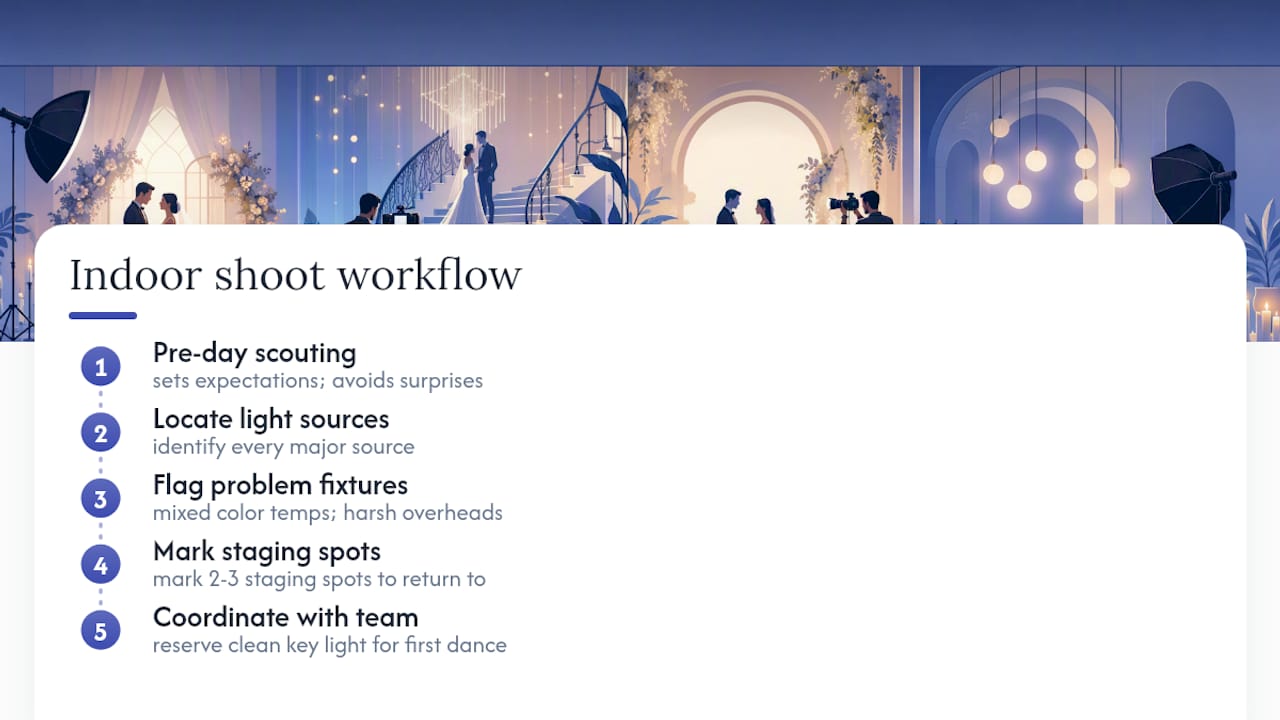
A short checklist when walking a new indoor venue is to locate every major light source, flag problem fixtures (mixed color temperatures, harsh overheads), and mark two or three staging spots worth returning to during the reception. Pre-production scouting like this sets expectations early and avoids surprises when the light changes at 7 p.m.
Coordinating directly with planners and lighting techs on key moments, like reserving a clean key light for the first dance, consistently produces better images than adjusting on the fly. It's a habit borrowed from lighting setup workflows built for photographers who work reception rooms regularly.
Ready to Photograph Your Indoor Wedding?
If you're planning a wedding inside a ballroom, historic building, or family home, the ideas above translate into a real conversation with whoever's behind the camera. Larson Pro Photography books wedding coverage built around exactly this kind of indoor-first planning, and pairs well with an engagement session if you want to test posing style before the big day. Couples who want the reception's energy captured in motion as well as stills can add videography to round out the coverage.
Why Indoor Weddings Deserve Better Than "Plan B" Energy
Too many couples treat an indoor venue like a consolation prize for bad weather odds, and that mindset shows up in flat, uninspired photos. The truth is architectural drama, a staircase, an arched doorway, low reception lighting, often produces more intimate images than an open field ever could. Candid interaction beats posed perfection almost every time indoors, where there's nowhere to fake it. My advice: walk into your planning meeting with three priorities for your photographer, not twenty. A short, clear list gets executed. A long wish list gets rushed.
— Todd
Sources
For deeper technical reading: ShutterReview's camera settings guide covers exposure ranges for dim venues, RMCAD's candid photography breakdown explains why unposed moments read stronger, and NYFA's pre-production guide walks through scouting basics any photographer can apply to a venue walkthrough.
- Top Tips for Capturing Stunning Indoor Wedding Photos | Hilary Elizabeth Photography
- Indoor wedding photography camera settings | ShutterReview
FAQ
How Do You Photograph an Indoor Wedding?
Prioritize window light for portraits, use bounce flash or diffusers to fill shadows without killing ambience, and lean on architectural features like staircases and archways as natural backdrops. Coordinate with your venue's lighting setup ahead of time so key moments like the first dance aren't left to chance.
What Is the 30-5 Rule for Weddings?
Definitions vary depending on who you ask, but it generally refers to giving guests a heads up thirty minutes before a key moment (like formal photos or the ceremony start) and a five-minute warning right before it happens. It's more of a planning courtesy than a strict photography rule.
What Are Good Indoor Photoshoot Ideas?
Window-lit portraits, staircase full-length shots, doorway silhouettes, and candid reaction shots during toasts or first dances all work well indoors. Detail shots, rings, bouquets, invitation suites, also photograph beautifully near natural light.
What Are Creative Ideas for a Wedding Photoshoot at Home?
Use large windows for soft portrait light, stage a hallway walking shot for movement, and photograph small details like the dress, shoes, or table settings against a plain background. A mirror or reflective surface can add an extra creative layer without needing more space.