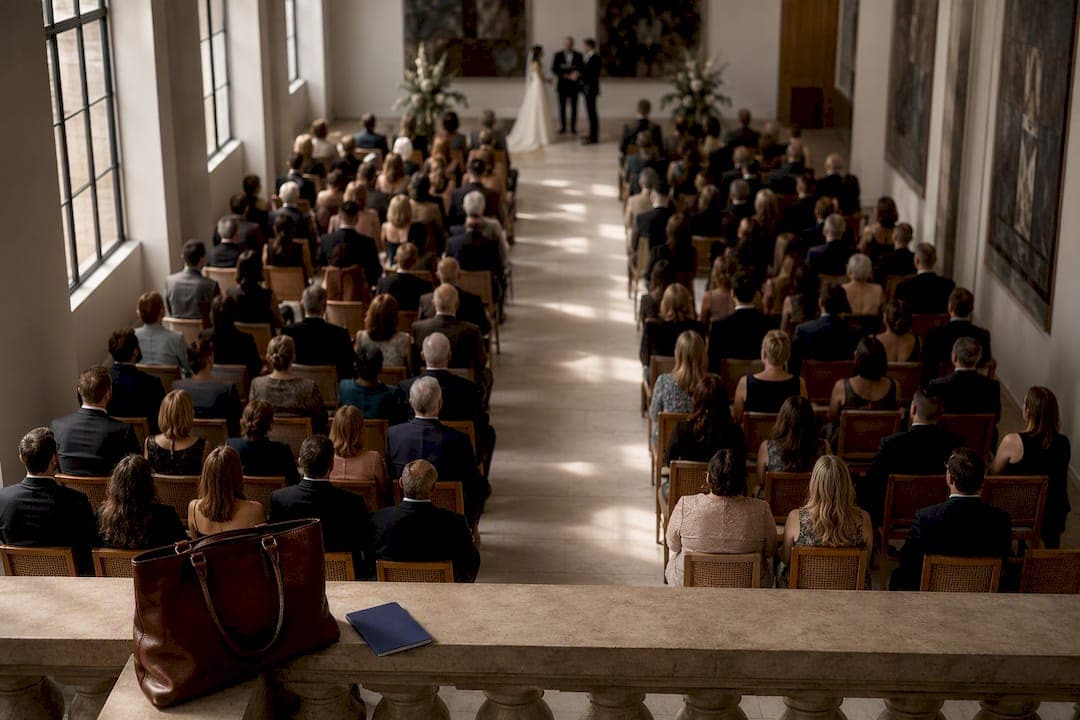
An unplugged ceremony means asking guests to put away phones, tablets, and cameras during the vows so everyone watches with their own eyes instead of a screen. The core reason couples choose it comes down to two things: presence and protection. Guests stay emotionally locked into the moment, and the professional photographer gets clean, unobstructed shots instead of a sea of raised arms and glowing rectangles. Most couples apply the rule to the ceremony only, not the reception.
TL;DR:
- Partial unplugged policies, covering only the processional and vows, significantly reduce visual clutter, making photos cleaner without completely restricting guest participation.
- Clear, repeated communication across wedding website, signs, programs, and officiant words greatly increases guest compliance and overall positive reception.
- Guest resistance mostly stems from wording and tone; invitations framed as a request to be present are more effective than strict rules that can cause resentment.
- Allowing phones for emergencies and setting up a designated person for casual photos helps address common guest objections while maintaining the unplugged goal.
- A flexible, multi-channel approach with consistent messaging leads to better photo quality, authentic reactions, and a more connected wedding experience.
Table of Contents
- Unplugged Wedding Ceremony Meaning: The Different Versions Couples Use
- Why More Couples Are Choosing to Go Unplugged
- What Guests Actually Push Back On (and How to Handle It)
- How to Announce an Unplugged Ceremony (With Sample Wording)
- Etiquette and Best Practices for Guests During an Unplugged Ceremony
- Where the Unplugged Wedding Trend Actually Came From
- How Unplugged Traditions Differ Across Cultures and Faiths
- A Photographer's View on Why Unplugged Ceremonies Work
- Where to Find Sample Wording and Etiquette Guidance
- Ready to Protect Your Ceremony Photos?
- A Photographer's Take on the Unplugged Debate
- Sources
- FAQ
Unplugged Wedding Ceremony Meaning: The Different Versions Couples Use
Not every unplugged policy looks the same. Some couples go all in; others just want the aisle clear for the entrance.
- Full unplugged: no phones or cameras from the moment guests sit down until the recessional. This is the strictest version and the one photographers tend to prefer.
- Partial unplugged: the rule applies only during the processional and vows, then guests are free to snap away once the couple kisses.
- Entrance-only unplugged: some couples only care about the walk down the aisle staying camera-free, since that's the shot they most want to see clean.
- Day-long unplugged: rarer, but a few couples extend the request through the reception too, usually to control when photos hit social media.
Professional photographers and videographers are always exempt, of course. They're the ones the policy is designed to protect in the first place. The right variation depends on what you care about most. If the ceremony's emotional beats matter more than anything, go full unplugged. If you just want a clean aisle shot for the album, entrance-only does the job without asking much of your guests.
Why More Couples Are Choosing to Go Unplugged
The benefits of an unplugged wedding ceremony show up in two places: how the day feels and how the photos turn out. Guests who aren't fumbling with a camera app tend to react more genuinely. Officiants and photographers both report more tears, more laughter, more of the reactions couples actually want captured.
Pro Tip: Ask your officiant to pause for two full seconds after "you may now kiss" before saying anything else. That beat, uninterrupted by guests scrambling for their phones, is often the single most-reprinted photo from the whole wedding.
The practical upside is just as real:
- Cleaner, unobstructed images since no one's arm or phone is blocking the aisle.
- Smoother videography, since a videographer doesn't have to dodge guests standing to get their own shot.
- More control over when photos go public, so the couple can share their own images first.
- Fewer interruptions, like a ringtone or a flash going off mid-vow.
Photographers who've worked both types of ceremonies consistently say unplugged weddings produce cleaner, more emotional images because there's simply less visual clutter to work around. That's not a marketing claim. It's a function of geometry: fewer raised arms in the frame means a cleaner frame.
What Guests Actually Push Back On (and How to Handle It)
Not every guest loves the idea, and pretending otherwise sets couples up for friction. The most common objection comes from grandparents or relatives who traveled far and want their own memory of the moment, not just the professional gallery weeks later. Others worry about missing a call from a babysitter or an elderly parent.
Reasonable exceptions solve most of this:
- Allow phones for medical or emergency reasons, and say so explicitly in your announcement.
- Offer a labeled phone drop-off table so anxious guests can still be reached if truly necessary.
- Designate one family member, if you want, to take casual shots during a specific moment, like the recessional.
- If distant relatives can't attend, set up a simple livestream instead of asking every guest to comply with a no-phone rule just so one person can watch remotely.
Tone matters more than the rule itself. A sign that reads "NO PHONES" lands very differently than one that reads "We invite you to be fully present with us today." Officiant guides note that wording and delivery determine whether guests feel invited or policed, and that distinction is the difference between happy compliance and quiet resentment.
How to Announce an Unplugged Ceremony (With Sample Wording)
Getting guests to comply isn't about one big warning. It's about layering the message so it never feels like an ambush.
- Set the expectation early. Mention it on your wedding website under the FAQ or ceremony details, so guests read it before they even pack.
- Repeat it on the invitation or RSVP card. A short line like "Our ceremony will be unplugged, please silence phones" plants the idea weeks in advance.
- Put it in the program. This is often the last reminder guests see before sitting down.
- Post a sign at the ceremony entrance. Place it where guests physically stop, like next to the guest book or at the aisle entrance, not tucked somewhere they'll walk past.
- Have the officiant say it out loud. This is the final and most effective layer, since it comes right before the processional when everyone's already seated and listening.
Experts who specialize in this exact logistics puzzle recommend combining pre-wedding notices, program wording, signage, and a verbal announcement rather than relying on just one channel, since compliance jumps dramatically when guests hear the request more than once.
Here's sample officiant language couples can hand straight to their celebrant:
Program copy can be even shorter: "Please turn off phones and cameras during our ceremony. We want to see your faces, not your flashes. Thank you for celebrating with us fully present."
For enforcement on the day, a staffed or labeled phone basket near the entrance works well, especially when paired with a friendly usher who can gently remind late arrivals. Adapted officiant scripts built for exactly this kind of moment can save time if you don't want to write your own from scratch.

Etiquette and Best Practices for Guests During an Unplugged Ceremony
Once a couple asks for an unplugged ceremony, the etiquette is simple: comply without making a scene about it. Silence your phone completely, not just on vibrate, since a buzzing phone during vows is nearly as disruptive as a ringtone. Leave the phone in a pocket or bag rather than holding it face down on your lap, since the temptation to glance at it during a quiet moment is real.
If you're seated on the aisle, resist the urge to lean out for a better view. That instinct is exactly what blocks the photographer's shot. If a moment truly deserves a personal photo, wait until the officiant announces the recessional or the reception begins, when the unplugged request has typically lifted.
Older relatives who aren't used to the concept sometimes need a gentle in-person reminder rather than expecting them to read a sign. If you're ushering or seating guests, a quiet "just a heads up, they've asked for no photos during the ceremony" goes a long way. The best guest behavior at an unplugged wedding mirrors good behavior at a play or a graduation: attentive, quiet, and camera-free until the formal moment ends.
Where the Unplugged Wedding Trend Actually Came From
Unplugged ceremonies aren't an old tradition. They emerged directly in response to smartphones, roughly in the early 2010s, once nearly every guest started carrying a camera capable of interrupting a professional shot. Before that era, a handful of disposable cameras on tables was the extent of guest photography, and it rarely interfered with the ceremony itself.
The tipping point came from photographers themselves, who started noticing recurring problems: guests stepping into the aisle for a better angle, phone screens lighting up bright enough to throw off exposure settings, and viral photos of officiants literally asking a guest to lower a tablet blocking the bride's entrance. Those images circulated widely and pushed the concept from a niche request into a mainstream wedding planning term almost overnight.
What started as a photographer's pet peeve became a guest-experience movement. Couples realized the same policy that protected their photos also gave their families a more genuine, connected wedding day. That dual benefit, part practical and part emotional, is why the term stuck around instead of fading as a passing trend.
How Unplugged Traditions Differ Across Cultures and Faiths
The concept flexes depending on the ceremony type. In many Christian church weddings, officiants and clergy have long asked for quiet and reverence during the service, so an unplugged request often fits naturally into existing customs about respectful silence.
Jewish ceremonies, particularly Orthodox weddings, sometimes already restrict photography during certain ritual moments for religious reasons, meaning an unplugged approach can align with existing practice rather than introducing something new. Hindu ceremonies, which often run long and involve multiple ritual stages, tend to take a more relaxed approach, since family involvement and documentation are woven into the tradition itself, though many couples still request unplugged moments during specific rites like the phera or mangalsutra.
Civil ceremonies and secular weddings show the widest range, since there's no built-in religious expectation either way. That's exactly why explicit communication matters more here than anywhere else. Without a cultural or religious frame already asking for quiet, a secular couple has to set the expectation entirely on their own, through signage, programs, and the officiant's own words.
A Photographer's View on Why Unplugged Ceremonies Work
Sightlines make or break a ceremony photo. When a guest raises a phone mid-aisle, it doesn't just block one frame, it forces a recomposition on the fly, and that split second can mean missing the groom's actual reaction to seeing his partner for the first time. Unplugged ceremonies remove that guesswork entirely, letting a photographer commit to a composition and trust it will stay clean.
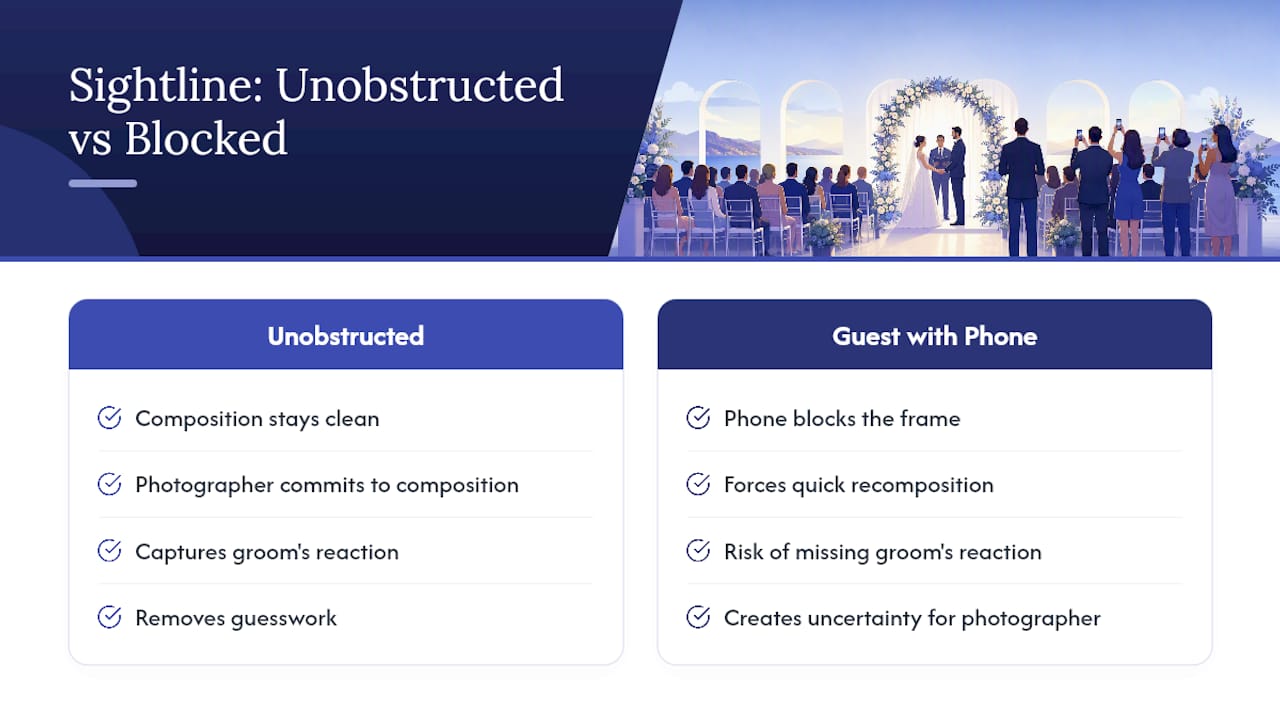
Coordination matters just as much as the policy itself. Photographers typically want to know where they can stand, whether a side aisle is available for a second angle, and if there's a planned "photo moment," often built in right before the processional, where guests can snap a few casual shots before the unplugged window begins. That single scheduled minute satisfies the urge to capture a memory without risking the ceremony itself, a tactic detailed further in how to get natural wedding photos for authentic memories.
Sharing timelines also come up more than couples expect. Many photographers deliver a same-day sneak peek specifically so couples have something to post before guests' own candid shots (taken after the ceremony ends) start circulating. If a videographer is also on-site, how a videographer positions during ceremonies depends heavily on whether guests are static and camera-free or shifting around trying to get their own footage.
Where to Find Sample Wording and Etiquette Guidance
For couples writing their own announcement, a few sources are worth bookmarking:
- The Knot's breakdown of unplugged ceremony pros and cons for balanced framing before you decide.
- Vancity Officiant's guide to wording and timing for tone-sensitive officiant scripts.
- Ordained Pro's ceremony script templates for adaptable, ready-to-use language.
Ready to Protect Your Ceremony Photos?
Couples who go unplugged consistently get cleaner galleries, and that starts with a photographer who knows how to coordinate the timing, the positioning, and the announcement with your officiant. Professional photographers work with couples to plan details like this before the wedding day, rather than scrambling during the processional. Browse real client galleries to see how unplugged ceremonies translate into finished photos, or look into an engagement session if you'd rather have images ready to share the moment your unplugged vows end.
A Photographer's Take on the Unplugged Debate
The most overlooked part of this whole conversation is that couples treat "unplugged" as an all-or-nothing decision when it's really a dial, not a switch. You don't need the strictest version to get most of the benefit. Even a partial policy, just covering the processional and vows, eliminates the vast majority of blocked shots and distracted reactions, because those few minutes are where nearly all the emotional payoff photos happen.
What surprises couples most is that guest resistance almost never comes from the policy itself. It comes from how it's worded. A sign that sounds like a rule generates eye rolls. A line that sounds like an invitation, something closer to "be here with us, not behind a screen," gets genuine buy-in, even from the relative who "never" complies with anything. The couples who get the smoothest ceremonies aren't the ones with the strictest rules. They're the ones who explained the "why" clearly enough that guests wanted to comply rather than felt forced to.
If there's a real mistake couples make, it's assuming one sign at the entrance is enough. It never is. The couples with zero phones in their aisle shots are the ones who mentioned it three or four times across different formats, because repetition, not strictness, is what actually changes behavior on a day when everyone's excited and half-distracted anyway.
— Todd
Sources
- All About Hosting an Unplugged Wedding Ceremony or Reception
- How (and Why) to Have an Unplugged Ceremony
- What Is an Unplugged Wedding Ceremony and How Can You Enforce One?
- What Is an Unplugged Wedding Ceremony? Wording, Timing and Guest Etiquette | Vancity Officiant Guide
FAQ
What does "unplugged" mean at a wedding?
It means guests are asked to put away phones, tablets, and cameras during the ceremony so they can be fully present and so the professional photographer isn't blocked. The request typically applies to the ceremony only, not the whole day.
What are the cons of an unplugged ceremony?
Some guests, especially older relatives or those who traveled far, may feel disappointed they can't take their own photos, and remote family members may need a livestream alternative arranged separately.
What should the officiant say during an unplugged ceremony?
A short, warm line works best, something like inviting guests to "put away phones and cameras and simply be present," framed as an invitation rather than a rule, since tone determines whether guests feel welcomed or restricted.
Is an unplugged ceremony worth it?
For couples who prioritize genuine guest reactions and clean, unobstructed photos, most industry coverage frames it as worth the small amount of upfront communication it requires, though it ultimately comes down to what the couple values more: guest convenience or photo and presence quality.
Do professional photographers still take photos during an unplugged ceremony?
Yes, the unplugged request applies only to guests. Photographers and videographers are always exempt and continue working exactly as planned throughout the ceremony.