A wedding consultation exists to do one job well: figure out fast whether a couple and a vendor are the right match before anyone signs anything. It qualifies fit, clarifies the couple's priorities and budget, and sets a clear path toward a proposal or a polite no.
Three things to know before your next meeting:
- It's a two-way interview. You're evaluating the vendor exactly as much as they're evaluating you.
- Price comes after value. A good consultation frames what you're getting before it names a number.
- There's always a next step. A real consultation ends with a timeline, not a vague "we'll be in touch."
If you're prepping for one, jump to the checklist section below. If you're trying to read a vendor's professionalism in real time, the agenda and red-flags section will help more.
Key Takeaways
A consultation works because it forces both sides to confirm fit, clarify priorities, and agree on next steps before any money changes hands.
| Point | Details |
|---|---|
| Consultations qualify fit first | Price and packages only matter once both sides agree the working relationship makes sense. |
| Format determines expectations | A 15 to 20 minute discovery call filters leads; a 45 to 75 minute full consult builds the actual proposal. |
| Preparation shortens the path | Bringing a budget range, guest count, and inspiration references speeds up a realistic proposal. |
| Follow-up has a rhythm | Expect a proposal within days and one or two follow-up touchpoints before a vendor assumes no interest. |
| Red flags show up early | Vague answers to direct questions or pressure to sign fast are worth taking seriously. |
Table of Contents
- The Role of Consultations in Weddings: A Quick Definition
- Discovery Call, Full Consultation, or Follow-Up: Which One Are You In?
- What Actually Happens During a Wedding Consultation?
- How a Consultation Protects You from Bigger Problems Later
- How to Prepare for Your Wedding Consultation
- What Happens After the Consultation Ends?
- Copy-Ready Templates for Running Your Own Consultations
- Why the Consultation Matters More Than the Portfolio
- Ready to See What a Real Consultation Feels Like?
- Frequently Asked Questions
- Sources
The Role of Consultations in Weddings: A Quick Definition
A wedding consultation is a structured meeting, usually 15 to 75 minutes, where a couple and a vendor determine whether they should work together. The vendor gathers details about the couple's vision, presents services and pricing, and everyone leaves knowing what happens next. That structure is what separates a consultation from a casual chat.
Every well-run consultation is working toward four goals at once:
- Qualifying fit — does this vendor's style, personality, and availability match what the couple actually wants?
- Clarifying priorities — what matters most: photography coverage, videography, guest experience, budget ceiling?
- Presenting value — showing services and packages in a way that connects to the couple's specific day, not a generic menu.
- Setting next steps — a proposal deadline, a follow-up call, or a clear reason to walk away.
Here's what that looks like in practice: a couple mentions they want candid, documentary-style coverage over posed portraits. A photographer who picks up on that during the consultation and tailors the proposal around it is far more likely to close the booking than one who sends a generic three-tier price sheet.
Discovery Call, Full Consultation, or Follow-Up: Which One Are You In?
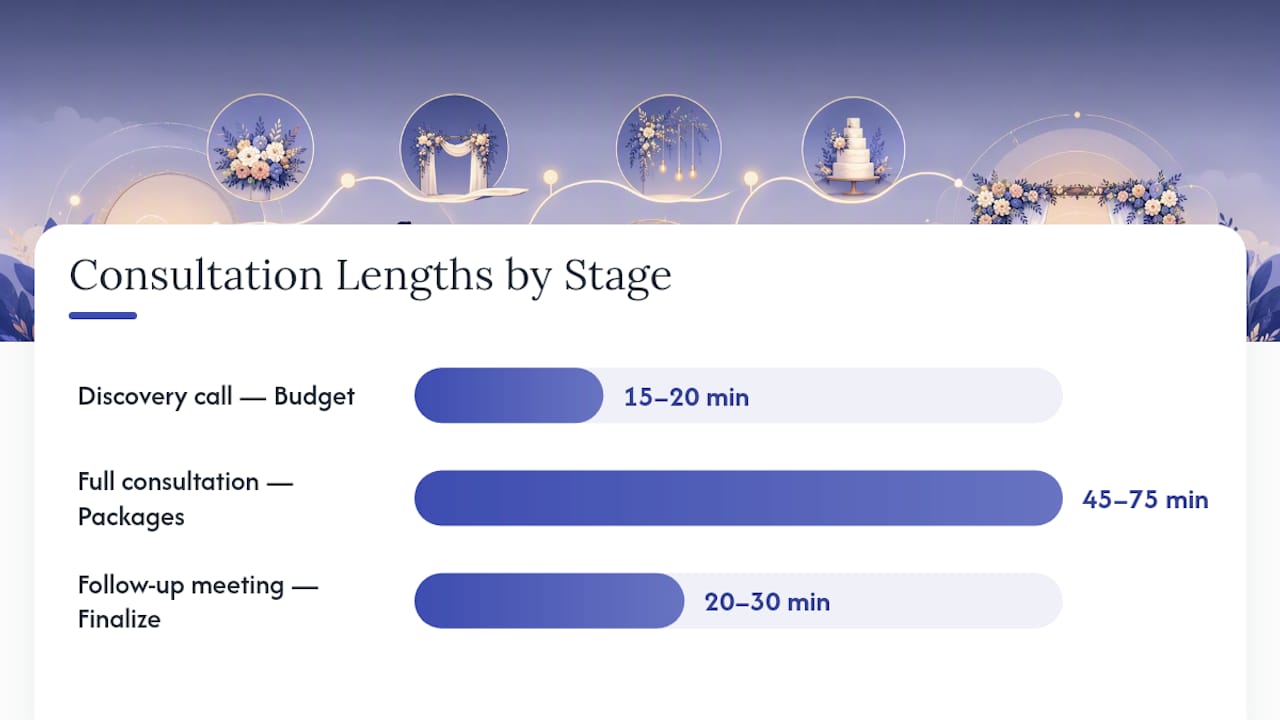
Most vendors run consultations in three stages, and knowing which one you're in changes what you should expect. A short discovery call filters out obvious mismatches before anyone invests real time. The full consultation is where the actual planning conversation happens. The follow-up meeting exists to finalize details and sign.
Skipping the discovery step is one reason some vendors see higher no-show and ghosting rates after a full consult, since neither side has confirmed basic fit or budget range beforehand, according to guidance from Virtual Wedding Academy.
| Format | Typical length | Best outcome |
|---|---|---|
| Discovery call | 15–20 minutes | Confirm budget range, date, and basic style fit |
| Full consultation | 45–75 minutes | Present packages, gather vision details, discuss pricing |
| Follow-up / contract meeting | 20–30 minutes | Finalize package, sign contract, confirm timeline |
If you're contacting five or six vendors, ask for a discovery call first. Save the full consultation for the two or three who actually feel right after that shorter conversation.
What Actually Happens During a Wedding Consultation?
A well-structured 45 to 75 minute consultation tends to follow a predictable rhythm, and knowing it in advance means you'll never feel caught off guard.
- Minutes 0–10: Introductions and vision-sharing. The vendor asks open-ended questions about your day, your style, and what matters most to you as a couple.
- Minutes 10–30: Logistics and details. Venue, date, guest count, timeline, and any complicating factors (multiple locations, cultural traditions, weather backup plans).
- Minutes 30–50: Services and pricing. Packages get presented in the context of what you've already shared, not as a generic list.
- Minutes 50–70: Questions and objections. This is where you should ask the harder questions.
- Final minutes: Next steps. A proposal timeline, a follow-up date, or a same-day decision if you're ready.
Vendors will typically ask about four categories of things: logistics (date, venue, timeline), budget (range, priorities within that range), guest experience (headcount, family dynamics, must-have shots or moments), and vision (style references, non-negotiables). A good initial consultation leans on open-ended questions rather than a rigid script, since that's what actually surfaces what a couple wants.
Your side of the question bank should include:
- What's included in this package, specifically, and what costs extra?
- How many weddings have you shot in a similar venue or season?
- What's your backup plan if you're sick or unavailable?
- How and when will we receive our final photos or footage?
- What's your policy on overtime, reshoots, or schedule changes?
Watch for vague answers to direct questions, pressure to sign before you've asked everything you wanted to, or a vendor who can't describe their own process clearly. Those are the moments that tell you more than any portfolio will.
How a Consultation Protects You from Bigger Problems Later
The visible benefit of a consultation is a clear proposal. The invisible benefit is everything it prevents.
- Reduces scope creep. You know exactly what's included before you pay a deposit, not after.
- Prevents budget surprises. Pricing gets discussed against your actual priorities, not a one-size-fits-all rate card.
- Protects your time. A 20-minute discovery call can save you from a two-hour meeting with the wrong vendor.
- Surfaces personality fit. You'll spend an entire wedding day with this person. A consultation is your only real preview of that.
Full-service wedding planners can log 150 to 250 hours on a single wedding, much of it invisible work like vendor negotiation and family diplomacy that never shows up on an invoice line. Photographers and videographers carry a version of that same hidden labor, from coordinating with other vendors to managing a shot list around a nervous mother-in-law.
An experienced professional often functions as a strategic buffer, absorbing awkward requests and vendor-to-vendor friction that couples never see until something goes wrong, according to Columbia Magazine's profile of planner Jove Meyer.
That's the real shift a good consultation creates: price stops being the first question and becomes the last one, asked only after both sides agree there's real value on the table.
How to Prepare for Your Wedding Consultation
Walking in with a few basics ready turns a vague conversation into a productive one, and it dramatically increases your odds of getting a proposal that actually fits.
Bring:
- A rough budget range, not a single fixed number
- An estimated guest count
- Your venue name and date, or your top two or three options
- A short list of must-haves and dealbreakers
- A few inspiration photos or a simple moodboard
Most vendors will also send an intake form before the meeting asking for similar details, plus your current vendor list, so they can flag scheduling conflicts early.
| What to bring | Why it matters |
|---|---|
| Budget range | Lets the vendor recommend realistic packages instead of guessing |
| Guest count estimate | Affects timeline, staffing, and coverage needs |
| Venue status | Confirms logistics and travel considerations |
| Inspiration references | Helps the vendor gauge style fit quickly |
Pro Tip: Give a budget range instead of a single number. A range like "$3,000 to $4,500" invites a real recommendation; a hard number invites a vendor to just hit it exactly, whether or not it fits your priorities.
What Happens After the Consultation Ends?
The consultation itself is only half the process. What happens in the days after tells you a lot about how the working relationship will actually run.
- Proposal delivery: Expect a custom proposal within 24 to 72 hours of a full consultation.
- First follow-up: If you haven't responded within about a week, most vendors will send one polite check-in.
- Second follow-up: A second touchpoint around two weeks out is standard before a vendor assumes you've gone another direction.
- Contract meeting: Once you're ready to move forward, expect a short call or meeting to finalize details and sign.
If you need changes, say so plainly: "This looks great, but could we adjust the coverage hours?" If you're passing, a simple "We've decided to go another direction, but thank you for your time" closes things cleanly and keeps the door open for a referral later.
Copy-Ready Templates for Running Your Own Consultations
If you're screening several vendors, borrowing a professional's own workflow saves you time on both ends.
Discovery script (15–20 seconds per line):
- "Tell me your date and venue."
- "What's your rough budget range for this service?"
- "What matters most to you about your coverage?"
60-minute consultation agenda:
- Minutes 0–10: You share vision and story (vendor listens, takes notes)
- Minutes 10–35: Vendor presents packages tied to what you said
- Minutes 35–50: Open Q&A, including budget specifics
- Minutes 50–60: Next steps and proposal timeline
Follow-up email templates:
- Proposal delivery: "Thanks for chatting today. Attached is a custom proposal based on everything we discussed. Let me know if you'd like any adjustments."
- Polite decline: "Thank you for your time. We've decided to go another direction, but we'd happily recommend you to other couples."
Pro Tip: Space your two follow-ups about a week apart. Sales research from HubSpot consistently shows multi-touch follow-up outperforms a single email, and wedding vendors see the same pattern.
Why the Consultation Matters More Than the Portfolio
I've watched enough couples go through this process to notice a pattern: the ones who ask hard questions during the consultation almost always end up happier with their photos later, regardless of which vendor they picked. It's not the portfolio that predicts satisfaction. It's whether the couple felt heard during that first real conversation.
At Larson Pro Photography, we treat every consultation as the start of the working relationship, not a sales pitch leading up to one. You can browse more planning guidance on our blog if you want to go deeper before your first meeting.
Ready to See What a Real Consultation Feels Like?
If you're comparing photographers for your San Antonio wedding, the fastest way to know whether Larson Pro Photography is the right fit is to sit down and talk it through. Browse the client galleries to see how past couples' visions turned into finished work, or start with an engagement session if you want a lower-pressure first look at how we work together before committing to full wedding-day coverage.
Frequently Asked Questions
How long does a typical wedding consultation last? A discovery call usually runs 15 to 20 minutes, while a full consultation typically takes 45 to 75 minutes depending on how detailed your vision and logistics are.
Do I have to pay for a wedding consultation? Most photography and videography consultations are free. They exist to determine fit before any contract or deposit is discussed.
What should I bring to a wedding consultation? Bring a rough budget range, estimated guest count, your venue details, a few inspiration photos, and a short list of must-haves and dealbreakers.
How soon should I expect a proposal after a consultation? Most vendors send a custom proposal within 24 to 72 hours, followed by one or two follow-up touchpoints over the next two to three weeks.
What if I don't feel a connection during the consultation? Trust that instinct. A consultation is designed to surface personality and communication fit, and it's completely normal to pass and keep looking.
Sources
- How to Run a Wedding Consultation That Books the Client Every Time
- What is the job of a wedding planner, really?
- How To Do An Initial Wedding Consultation - Guide 2026