Zola stands out as the best overall wedding invitation website because it pairs strong design libraries with the guest-list and RSVP tools that actually save couples hours of manual work. Minted wins for artist-made designs and premium printing, Vistaprint takes the budget category, Greenvelope leads for eco-conscious digital invites, and Etsy is unbeatable for one-of-a-kind, handmade stationery. Short reviews, ordering logistics, and a buyer's checklist follow below.
TL;DR:
- Choosing the right site depends on matching your design preference, guest-list needs, and budget, with options varying from handmade to fully digital invitations.
- Order samples six to eight months in advance to verify paper color and weight, and confirm turnaround times, guest sync, and reprint policies before finalizing.
- Extra costs often come from envelopes, liners, postage, and rush or bespoke customization, so budget for these line items beyond the base price.
- Digital invitations like Greenvelope and Paperless Post offer instant sending and RSVP tracking, but physical options like Minted and Vistaprint provide premium finishes and tangible quality.
- Coordinate with your photographer by sharing invitation images and color details to ensure your wedding photos reflect your chosen aesthetic.
Table of Contents
- Best Wedding Invitation Websites at a Glance
- What Matters When Choosing a Wedding Invitation Site
- Detailed Reviews of the Top Invitation Websites
- Your Pre-Order Checklist and Vendor Questions
- Ordering Timeline, Addressing, and Postage Logistics
- What Wedding Invitations Actually Cost, Fees Included
- Comparing the Shopping Experience Across Sites
- Beyond Templates: Real Customization Options
- Why Your Invitation Design Should Talk to Your Photographer
- Let Your Photography Match the Invitations You Chose
- Sources
Best Wedding Invitation Websites at a Glance
Picking an invitation site comes down to matching what a company does best to what you actually need. Some couples want a designer name attached to their suite. Others just want the RSVPs to sync automatically so nobody has to chase down forty phone numbers in July.
Here are the ten sites worth your shortlist, ranked by overall usefulness rather than price alone:
- Zola — Best for integrated planning. Free samples, free guest addressing, and RSVPs that sync straight to Zola's Guest List Manager. Mid-range pricing. Order your free sample kit before finalizing wording, since seeing the paper stock changes minds more often than you'd think.
- Minted — Best for artist-designed stationery. Independent-artist marketplace with letterpress and foil-press options. Mid to premium pricing. Book the design customization service early; slots fill up during peak spring booking season.
- Etsy — Best for bespoke, handmade invites. Independent sellers, huge material variety, from wax seals to hand-painted watercolors. Budget to premium, depending on seller. Message the seller directly about turnaround before ordering, since timelines vary wildly shop to shop.
- Paperless Post — Best for blended digital-plus-print with designer collaborations. Coins-per-card pricing model for digital sends. Mid-range. Buy a small coin bundle first to test a design before committing to your full guest count.
- Greenvelope — Best for premium digital invitations. Polished, wedding-specific templates and sustainability-minded messaging since there's no paper waste. Mid-range. Preview the mobile RSVP flow before sending; that's where most guests will respond.
- Vistaprint — Best for affordable printed invitations. Free sample kits, broad printing options, and built-in design help. Budget-friendly. Watch for upsells at checkout. Envelopes and liners often cost extra.
- Mixbook — Best for photo-forward designs. Flexible photo templates, free samples. Budget to mid-range. Upload high-resolution engagement photos, since low-res images get pixelated fast on foil finishes.
- Shutterfly — Best for couples who want photo-centric invites matched to a printed album. Budget to mid-range. Order a physical proof, not just the digital preview, before your full print run.
- The Knot — Best for a cohesive suite matched to a free wedding website. Basic addressing tools included. Budget to mid-range. Set up your wedding website first, then design invites to match its color palette.
- Paper Source — Best for tactile samples and in-person help. Brick-and-mortar stores plus online ordering. Mid-range. Visit a store location if one's nearby. Feeling the paper weight in person is worth the trip.
What Matters When Choosing a Wedding Invitation Site
Every site on this list looks good in a browser tab. The differences show up once you're deep into ordering, and by then it's expensive to switch. Here's what actually separates a smooth experience from a frustrating one.
- Free samples: Paper color shifts under different lighting and screen calibration. A physical sample kit prevents the "this isn't the cream I ordered" moment.
- Addressing and guest-list integration: Sites that offer free recipient address printing save real hours. Zola's guest-list tools sync directly with RSVP tracking, so you're not managing two spreadsheets.
- RSVP flow: Digital-first platforms increasingly prioritize instant RSVP updates because traditional email invites get caught in spam filters more often than people expect.
- Print finishes: Letterpress and foil cost more but photograph beautifully; flat digital printing is fine for casual weddings.
- Sustainability: Look for FSC-certified or recycled paper stock if that matters to you. Not every site discloses this clearly, so check the product page footnotes.
- Return and reprint policy: A vague reprint policy is a red flag. Know the turnaround before you need it.
Pro Tip: Order your sample kit the same week you book your venue. Paper stock decisions get rushed when they're an afterthought, and rushed decisions usually cost more to fix.
Detailed Reviews of the Top Invitation Websites
Minted
Minted built its reputation on an independent-artist marketplace, and it shows in the range of styles available, from minimalist line art to maximalist botanical illustration. The platform offers free sample kits and premium printing options including letterpress and foil-press, which is rare at this price point. Design customization services let you tweak an existing template rather than starting from scratch, though pushing a template significantly further sometimes carries an extra fee and requires advance coordination. Ask about revision limits before you commit to a custom job.
Zola
Zola's strength isn't any single design. It's the logistics layer wrapped around the design library. The Guest List Manager syncs addressing and RSVP tracking automatically, which means you upload your list once and stop re-entering the same names into three different tools. Free recipient address printing is included, and the sample kits are genuinely free, not a "pay shipping" trick some competitors run.

Etsy
Etsy is the place for couples who want something no one else at any wedding this year will have. Independent sellers offer wax seals, hand-calligraphy, vellum overlays, and material combinations you won't find on a template-driven site. The tradeoff is consistency: quality and turnaround depend entirely on the individual shop, so read reviews and message sellers about timelines before ordering.
Paperless Post
Paperless Post pairs designer collaborations with a hybrid business model. It sells both fully digital sends and printed pieces, and historically prices digital invitations through a coins-per-card system. That model rewards couples who buy a small test bundle before committing to a full guest count, since coin costs can add up faster than a flat per-invite price.
Greenvelope
Greenvelope occupies the premium digital lane. Its templates are wedding-specific rather than generic party invites, and the pricing reflects that positioning. Couples who want a paperless send that still feels considered, not just an Evite from 2009, tend to land here.
Vistaprint
Vistaprint is the practical choice when budget is the deciding factor. Sample kits and professional design assistance are included even at lower price points, which is unusual for the category. Watch for add-on costs at checkout: envelopes, liners, and expedited shipping aren't always bundled into the sticker price you see first.
Mixbook
Mixbook's photo-editing tools are more flexible than most competitors', which matters if your invitation suite centers on an engagement photo rather than illustration or typography. Templates adjust cleanly around uploaded images instead of forcing a fixed crop.
Shutterfly
Shutterfly's photo-printing pedigree carries into its invitation suites. If you're already ordering a photo album or holiday cards through the platform, keeping invitations there too creates a matching visual thread across your wedding paper goods.
The Knot
The Knot's invitations exist to match its free wedding websites, and that cohesion is the whole pitch. Build your website first, pick a color palette, then design invitations that echo it. Basic addressing tools are included, though they're less robust than Zola's.
Paper Source
Paper Source is the one entry on this list with physical stores. If you're the type who needs to feel cardstock weight before trusting a screen preview, a Paper Source location gives you that option alongside standard online ordering.
Your Pre-Order Checklist and Vendor Questions
Before you click "place order," run through this list. Skipping any one of these steps is how couples end up paying for rush shipping they didn't budget for.
- Order a sample kit and confirm the paper weight and color match what you expected on screen.
- Confirm how many proof rounds are included before revisions start costing extra.
- Request the vendor's CSV template for your guest list, don't build your spreadsheet first and hope it matches.
- Confirm turnaround time in writing, including what happens if you need a reprint.
- Check whether the site's default trim size affects postage. Square and oversized invitations often need extra stamps.
Before committing, send vendor support these five questions:
- Are samples available for the exact design I'm considering, or only generic stock?
- What's the standard proof turnaround, and is expedited proofing available?
- How does guest-list sync work, and what format does my spreadsheet need to be in?
- What size will my final invitation be, and what will postage likely cost?
- What's the reprint lead time if something arrives damaged or wrong?
Pro Tip: If a site can't tell you a specific reprint lead time, that's your answer. Move on before you're stuck mid-crisis three weeks before the wedding.
Red flags worth walking away from: no samples offered at all, a proofing process that requires back-and-forth emails instead of an online proofing tool, and digital invitation pricing that hides per-guest fees until checkout.
Ordering Timeline, Addressing, and Postage Logistics
Order sample kits six to eight months before the wedding. That window gives you time to check paper color reliably without feeling rushed if a reprint is needed. Finalize wording about four to five months out, and place your full printed order three to four months before the wedding to leave buffer room for shipping delays.
Addressing sounds simple until you're formatting a guest list. Most couples underestimate how much labor goes into hand-addressing envelopes, and free automated addressing only works cleanly if your spreadsheet matches the vendor's exact CSV template: separate columns for title, first name, last name, and address lines, not one messy "Full Name" field.
Postage catches people off guard. Square invitations, bulky pocket folders, and anything over standard letter thickness usually needs extra postage, sometimes significantly more than a standard stamp. Weigh a finished sample at the post office before buying stamps for 150 envelopes. Set your RSVP deadline three to four weeks before your final headcount is due to caterers, giving you a real buffer for stragglers.
What Wedding Invitations Actually Cost, Fees Included
Sticker prices rarely tell the full story. A pack of 100 printed invitations might list at a budget-friendly rate, but envelopes, liners, and postage often ride as separate line items. Vistaprint and Shutterfly tend to bundle basic design help into the base price, while premium foil or letterpress finishes at Minted or Paper Source push the total meaningfully higher per piece.
Digital platforms flip the cost structure. Paperless Post's coins-per-card model means your per-invite cost scales with design complexity, so a heavily embellished digital suite can cost more per send than a simple one. Greenvelope's premium templates carry premium pricing too, though you skip printing and postage entirely.
Rush orders are where budgets blow up fastest. Standard turnaround runs one to three weeks depending on the vendor and finish, but expedited printing, especially for foil or letterpress, can add a substantial surcharge on top of faster shipping fees. Always ask for the rush price before you're desperate enough to pay whatever's quoted.
Customization is the other hidden cost. Basic template edits, swapping colors or fonts, are usually free. Requesting a fully bespoke layout, custom illustration, or hand-lettering typically requires a designer service fee and a longer lead time. Budget accordingly if you know you want something beyond the template library.
Comparing the Shopping Experience Across Sites
Website usability varies more than you'd expect for a category this mature. Zola and The Knot both benefit from being full planning platforms, so invitation shopping happens inside a familiar dashboard you're already using for registries and websites. Minted and Etsy lean more marketplace-style, with heavier browsing and filtering, which rewards patience but can feel slower if you already know what you want.
Customer service quality tends to track with price tier. Premium and marketplace sites like Minted and Paper Source often provide direct design consultations or in-store staff, while budget-focused sites like Vistaprint rely more on self-service tools and FAQ-driven support. That's not a knock. It's simply a different service model built around a different price point.
Turnaround times split roughly into three tiers: digital invites from Greenvelope or Paperless Post send within minutes of finalizing a design, standard printed invitations typically take one to two weeks for proofing and production, and highly customized or letterpress orders can run three weeks or longer before they ship. Build your calendar around the slowest tier you're considering, not the fastest, so you're not scrambling if a proof needs a second round.
Beyond Templates: Real Customization Options
Template libraries only take you so far if you want your invitations to feel genuinely yours. Most sites now offer some layer of deeper customization beyond swapping a font color.
Monogram design is common across Minted, Paper Source, and Etsy, where a custom initial lockup can carry through invitations, programs, and even a dance-floor projection. Theme-driven suites, think destination motifs, vintage botanical illustration, or modern line art, are strongest on marketplace platforms where independent artists have already built out full collections rather than a single card design.
Bespoke design work, where an artist builds something from a blank page rather than editing a template, is available through Etsy sellers, Minted's design services, and specialty studios that work directly with couples on commission. This route costs more and takes longer, so pairing an invitation designer with your overall visual plan early avoids a mismatch between your paper suite and everything else at the wedding.
Why Your Invitation Design Should Talk to Your Photographer
Invitation choices carry more visual weight than most couples realize. The color palette, paper texture, and typography you pick end up back in your wedding photos: flat-lay detail shots of the invitation suite next to rings, florals, and place cards are a standard shot list item, and they photograph better when the photographer knows what they're working with in advance.
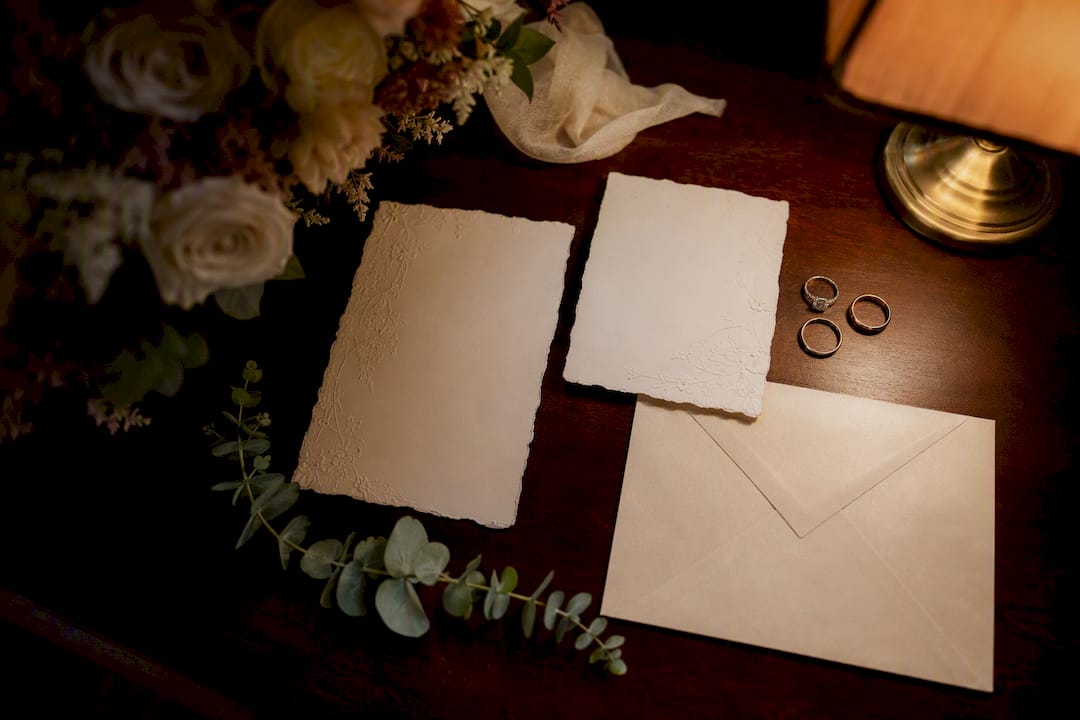
Before your wedding day, send your photographer a few things: a photo of the actual invitation (not just a screen preview), the color palette in hex codes or paint swatches, and the font names if you know them. That lets a photographer plan lighting and styling for the flat-lay shots instead of improvising on the morning of. Coordinating these details with your vendors ahead of time closes the gap between what you designed on paper and what shows up in your gallery.
A brief doesn't need to be formal. A short email with a sample photo, your palette, and a note on the mood you're going for (romantic and soft, bold and modern, vintage and textured) gives a photographer everything needed to shoot your details well.
— Todd
Let Your Photography Match the Invitations You Chose
You've picked a stationery style, whether it's Minted's letterpress or Zola's clean modern templates, and understanding various wedding photography styles can help you ensure your photos complement your invitation aesthetic perfectly. Larsonprophotography helps make sure your photography carries that same visual language through the entire day, from the flat-lay detail shots to the final gallery. Instead of guesswork, you send a photo of your invitation suite and your color palette ahead of time, and your photographer builds the shot list around it.
Larsonprophotography serves couples planning weddings in San Antonio and the surrounding area, with engagement session options for couples who want a warm-up shoot before the big day. Browse recent client work to see how invitation details show up in finished galleries, then reach out to check date availability for your wedding.