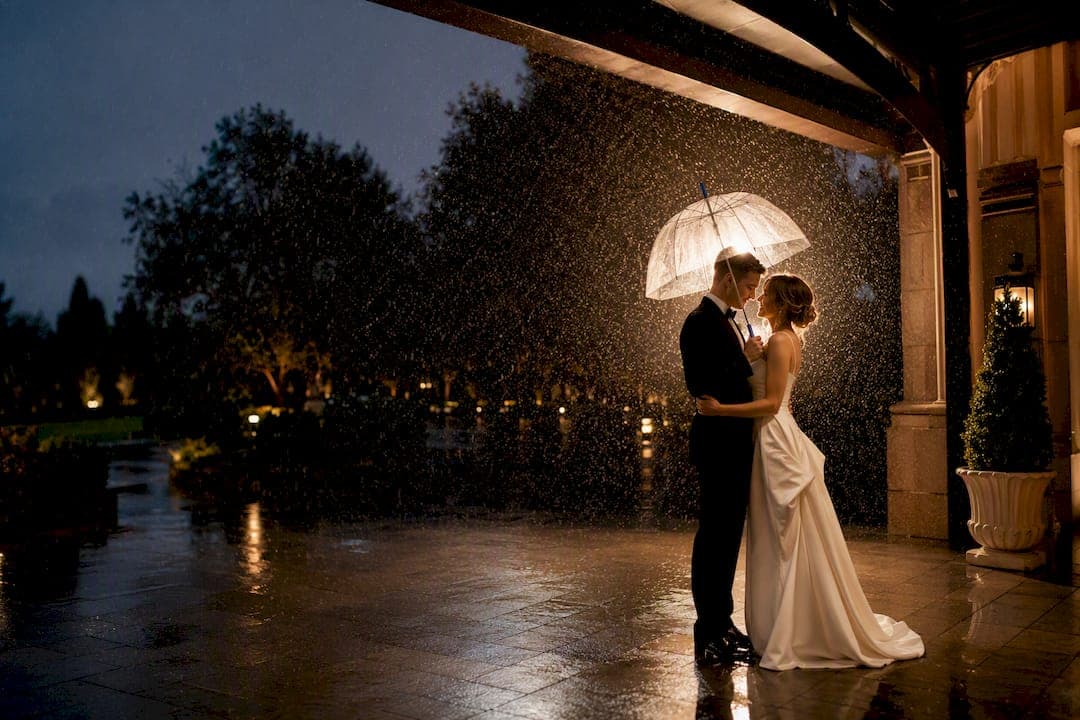
Yes, rainy day wedding photos can be some of the best images from your entire wedding. Overcast skies work like a giant softbox, softening light and deepening colors in ways full sun rarely does. The three moves that matter most: pack clear umbrellas, walk the venue for multiple backup spots, and build some buffer time into your timeline. Do those three things and rain stops being a threat and starts being a lighting tool.
TL;DR:
- Proper planning of backup locations, a detailed rain timeline, and communication with the team can ensure smooth wedding photography despite rain.
- Cover locations like porches, conservatories, and parking structures should be scouted beforehand to serve as effective rainy-day photo spots.
- Photographers should pack specific gear such as rain covers, microfiber cloths, and multiple umbrellas to protect equipment and facilitate quick outfit or hair touch-ups.
- Using backlighting, fast shutter speeds, and wide apertures helps create visually stunning rain photos that turn raindrops into artistic elements rather than nuisances.
- Romantic rain shots often involve poses like shared umbrella kisses, puddle reflections, and silhouettes, with clear umbrellas maintaining facial visibility.
Table of Contents
- Creative Rainy Day Wedding Ideas Worth Planning For
- Build a Rainy-Day Timeline Before the Weather Decides For You
- Where to Take Wedding Photos If It Rains
- What to Pack: Camera and People Protection
- Photography Techniques That Make Rain Look Intentional
- Poses and Props That Read Well in the Rain
- Where the Best Shots Happen After the Rain Lets Up
- Your Printable Rainy-Day Wedding Photo Checklist
- How to Dress for a Rainy Wedding Without Sacrificing Style
- Makeup That Survives Rain: What Actually Holds Up
- How to Talk to Your Wedding Party and Guests About the Rain Plan
- Staying Safe on Wet Ground During the Shoot
- A Photographer's Honest Notes on Shooting Through Rain
- Book a Rain-Ready Wedding Photographer
- Where to Learn More About Rain Forecasts and Photography Technique
- Sources
- FAQ
Creative Rainy Day Wedding Ideas Worth Planning For
Rain photos work because they force intimacy. Two people under one umbrella, foreheads close, rain blurring everything else into a soft gray backdrop. That single frame often outperforms a dozen sunny-day shots because it looks like a moment instead of a pose. Real wedding galleries consistently show umbrellas, puddle reflections, and empty streets as the images couples request again and again from their albums.
A few concepts worth putting on your shot list:
- Shared umbrella portraits. The classic shot, but ask your photographer to shoot tight on faces first, then pull back for a wide frame that shows the rain itself.
- Empty street or alley walks. Rain clears sidewalks and streets of people, giving you a clean, cinematic backdrop that would be impossible on a dry, crowded day.
- Puddle reflections. A low camera angle turns a parking lot puddle into a mirror. Brides in particular photograph well doubled in reflection.
- Canopy group shots and candid reception moments. Guests huddled under a tent, laughing at the weather, often make better candid photography than posed group shots ever do.
Think of rain as changing your shot list, not shrinking it.
Build a Rainy-Day Timeline Before the Weather Decides For You
The single biggest mistake couples make is treating rain as an emergency instead of a planned contingency. A rainy-day timeline isn't a backup document you hope to never open. It's a second version of your day, built in advance, with the same level of detail as your main schedule.
Here's how to build it:
- Draft a Plan B for every outdoor block. For each portrait session scheduled outside, name a covered alternate location at the same venue or within a five-minute drive.
- Add a buffer of 10 to 30 minutes. Rain rarely falls at a constant rate. A short buffer lets your photographer wait out a squall or catch a clearing window without throwing off the reception.
- Reserve a short "just in case" slot late in the day. Storms often break for a few minutes right around sunset. Holding ten unscheduled minutes for a possible clearing sky has saved more than a few wedding galleries.
- Notify the full team. Your photographer, planner, venue coordinator, and at least one attendant should have a copy of the rain plan a week before the wedding, not the morning of.
- Designate an umbrella holder. Someone other than the photographer needs to hold umbrellas during portraits so both hands stay free for the camera.
Pro Tip: Print the rainy-day timeline on a separate colored page from your main schedule. When weather turns, your planner can hand it out at a glance without flipping through the whole binder looking for the right section.
Photographers who scout three to five covered backup spots and share the rain timeline with vendors at least two weeks out consistently report smoother wedding days, rain or shine.
Where to Take Wedding Photos If It Rains
Scout these locations at your venue walkthrough, not the week of the wedding:
- Porches, overhangs, and wide doorways. These keep natural light on your faces while blocking the rain overhead, which beats a flash-lit interior every time.
- Conservatories or covered patios. Glass ceilings let diffused daylight in while keeping everyone dry, giving you the best of both indoor and outdoor light.
- Parking structures. Not glamorous, but the repeating concrete lines and shadow patterns make for surprisingly editorial, moody frames.
- Covered bridges or breeze ways. If your venue or a nearby park has one, it's often the single best rain backup on the property.
Pro Tip: Have your photographer stand under the cover while the couple steps just to the edge of the rain. It keeps the camera dry and still captures genuine raindrops falling around the couple instead of a scene that looks staged indoors.
What to Pack: Camera and People Protection
Rain punishes unprepared gear and unprepared outfits equally. The gear list photographers actually pack for rain shoots covers both.
For the camera:
- Rain covers or sleeves for each camera body and lens.
- Large zip-lock bags as a backup barrier if a proper rain cover isn't available.
- Microfiber cloths, several of them, because a single raindrop on the lens can ruin many consecutive frames.
- Extra batteries. Cold, wet conditions drain power noticeably faster than a dry, warm afternoon.
For the couple and party:
- Two or more clear umbrellas, since clear umbrellas preserve facial lighting and keep expressions visible in a way opaque umbrellas never do.
- Heel guards or a spare pair of comfortable shoes for walking on wet grass or pavement.
- A garment bag to protect dresses and suits between locations.
- A small touch-up kit for hair and makeup between portrait sessions.
Pro Tip: Wipe the lens before every single frame in steady rain, not just when you notice a spot. One missed drop can blur an otherwise perfect shot, and you often won't catch it until you're reviewing images at home.
Photography Techniques That Make Rain Look Intentional
Good rain photography isn't luck. It's a handful of deliberate camera settings that turn raindrops from a nuisance into a visual effect.
Backlighting is the biggest lever. Position a light source, natural or a rim flash, behind the couple so raindrops between the light and the camera catch the illumination and sparkle rather than disappear into a flat gray frame. Shutter speeds around 1/500th of a second or faster freeze individual droplets in sharp focus; slower speeds blur the rain into soft streaks, which works better for wide, moody shots.
On aperture and ISO: overcast skies cut available light substantially, so most photographers open the aperture wider before pushing ISO higher, since a wider aperture keeps noise down while still gathering enough light. Overcast conditions function as a natural softbox, which means skin tones often look more even in rain than in harsh midday sun. That said, flat gray light can also pull warmth out of skin tones, so a warming gel on a rim flash keeps faces looking natural instead of cold and blue.
A practical setup: place a flash behind and slightly to the side of the couple, angled back toward the camera, with the couple positioned just forward of that light so the falling rain passes directly through the beam. Combine that with a wide aperture to keep the couple sharp while the droplets render as soft, glowing points rather than distracting streaks.
- Backlight or rim flash to catch raindrops.
- 1/500s or faster to freeze drops; slower to blur them for mood.
- Wide aperture plus moderate ISO bump on overcast days.
- A warming gel to counter flat, cool rain light.
Poses and Props That Read Well in the Rain
Rain photos live or die on pose choice. A pose that works beautifully in sun can look stiff and awkward once umbrellas and puddles enter the frame.
- The shared-umbrella kiss. Tilt the umbrella just enough to frame both faces without hiding either one.
- Faces framed by umbrella edges. Shoot from slightly below, letting the umbrella's curve act as a natural vignette around the couple.
- Walking-away silhouette. The couple walking down a wet street under one umbrella, shot from behind, is one of the most requested rain images in modern wedding galleries.
- Low-angle puddle reflections. Get the camera close to the ground so the couple appears twice in frame, once real and once reflected.
Stick to clear or neutral umbrellas for anything showing faces. Save one bold, colored umbrella for a single deliberate accent shot rather than scattering colors across every frame, which tends to compete with the dress and florals instead of complementing them.
Where the Best Shots Happen After the Rain Lets Up
The back side of a storm often produces the best light of the entire day. Wet pavement and puddles stay reflective and saturated for an hour or more after rain stops, and that wet surface can double an image's compositional interest when shot from a low angle.

If the rain breaks anywhere near sunset, that clearing window can produce genuinely dramatic light, gold tones bouncing off wet streets and glass. It's worth holding a short, unscheduled slot late in the timeline specifically for this. If rain never lets up, indoor window light and glossy floors or mirrors still give a cinematic alternative that doesn't feel like a compromise.
Your Printable Rainy-Day Wedding Photo Checklist
Hand this to your planner or tape it inside your wedding binder:
- Two or more clear umbrellas.
- Microfiber lens cloths, at least three.
- Camera rain cover or large zip-lock bags.
- Extra camera batteries.
- Heel protectors or a backup pair of shoes.
- A garment bag for dresses and suits.
- A small touch-up kit for hair and makeup.
- A printed copy of the rainy-day timeline.
Check this against your general wedding photography checklist a week before the wedding, not the morning of.
How to Dress for a Rainy Wedding Without Sacrificing Style
Rain changes what "practical" means for a wedding dress. Trains drag through puddles fast, so many brides ask their photographer for a lifted-train shot early, then let a bridesmaid manage the train during transitions between covered spots. A dress with a shorter train or a bustle option built in ahead of time saves real stress once the ground turns wet.

Fabric choice matters more than people expect. Heavier satin and structured fabrics shed water better than delicate chiffon or lace, which can look beautiful but soak through and cling in ways that show in photos. If your dress is already chosen, a fabric-safe water-repellent spray applied days in advance adds a layer of protection without changing how the dress looks.
For hair, humidity is the real enemy, not the rain itself. Loose curls and soft waves tend to hold up better than sleek, straight styles, which frizz and fall flat fast in damp air. A stylist who uses a strong-hold, humidity-resistant spray, and packs a small touch-up kit for the bridal party, saves multiple reshoots later in the day. Updos generally survive rain better than down styles, since less hair is exposed to the moisture in the air.
For the wedding party, dark suits hide water spots far better than light gray or tan. A spare pair of dry socks for the groom and groomsmen is a small detail that photographs matter more than people realize, since wet shoes show in nearly every full-length frame.
Makeup That Survives Rain: What Actually Holds Up
Waterproof isn't a marketing word here, it's a requirement. Mascara, eyeliner, and brow products all need a genuine waterproof formula, not just "long-wearing," since rain and humidity behave differently than sweat and regular wear.
A few product categories matter more than others on a wet day:
- Setting spray, applied twice. Once after full makeup application, and again right before stepping outside for portraits.
- Cream and stick products over powder. Powder blush and highlighter tend to streak when hit with moisture; cream formulas sit closer to the skin and resist water better.
- Waterproof mascara and eyeliner, tested in advance. Ask your makeup artist to test the exact products on your skin days before the wedding, not the morning of.
- A matte or satin finish foundation. Dewy finishes look beautiful in photos on a dry day but can read as damp or shiny once real humidity and rain enter the picture.
Your makeup artist should also pack blotting papers and a compact for quick touch-ups between locations, since even waterproof products can shift after direct rain contact on the face. Building in five minutes before each major photo block for a quick mirror check keeps the whole wedding party looking fresh across every backup location, not just the first one.
How to Talk to Your Wedding Party and Guests About the Rain Plan
Silence creates panic. The moment a forecast shows real rain, whether it's a 30% or an 80% chance, tell your wedding party and immediate family the plan, calmly and specifically. Vague reassurance like "we'll figure it out" makes people anxious; a specific plan makes them relaxed.
Explain what a percentage actually means, since the National Weather Service defines Probability of Precipitation as the chance that at least 0.01 inches of rain falls somewhere in the forecast area, not a guarantee of rain the entire day. A 40% forecast often means scattered showers, not a washout, and knowing that distinction keeps everyone from overreacting to a slightly damp forecast.
For guests, a short note on the wedding website or a card in the program works well: mention that umbrellas will be available, that the ceremony has a covered backup location, and that photos will proceed rain or shine. People handle weather changes far better when they know there's a plan already in motion.
Your planner and photographer should also have a single point of contact, usually the maid of honor or best man, who relays real-time updates without the couple needing to check their phone all day. That one small structural choice removes an enormous amount of stress from two people who have better things to think about on their wedding day.
Staying Safe on Wet Ground During the Shoot
Wet grass, tile, cobblestone, and marble all turn genuinely dangerous once rain hits them, and a long dress or heels makes the risk higher. A few precautions prevent a beautiful rainy portrait session from turning into an injury.
Scout locations with footing in mind, not just light. A gorgeous cobblestone alley photographs beautifully but can be treacherous in dress shoes when wet; check surfaces during the same walkthrough where you're identifying backup spots. Photographers and planners should flag any steps, uneven pavement, or metal surfaces like drain covers and manhole plates, since those get slick fastest.

Bring a spare pair of flat, dry shoes for the actual walking between locations, saving heels strictly for posed shots. Ask an attendant to physically walk alongside the bride during transitions on wet or uneven ground, both to steady her and to hold an umbrella so both of her hands stay free.
Camera gear presents its own hazard. Wet floors near covered areas can be just as slick for a photographer carrying two camera bodies as for a bride in heels, so keeping a firm grip and moving slowly between spots protects both people and equipment.
A Photographer's Honest Notes on Shooting Through Rain
Rain does not ruin a wedding day. It changes the job, but it rarely makes the job worse, and that distinction gets lost in a lot of anxious wedding planning conversations. Experienced wedding photographers' shot lists and blogs reflect years of weddings where storms rolled through mid-ceremony and the resulting galleries turned out stronger for it, not weaker.
One block worth describing plainly: a couple's formal portraits moved under a venue's front porch when a storm hit thirty minutes before the ceremony. Backlight from a single flash behind the columns caught the falling rain in the frame, while the porch roof kept both the couple and the camera dry. The image that came out of that ten-minute block ended up being the one printed for their parents' anniversary gift.
The operational lesson is simple. Pre-scout every covered option at the walkthrough, pack spare batteries and cloths without being asked, and brief the wedding party on the rain plan before anyone starts asking nervous questions. Preparation, not luck, is what makes rainy day wedding photos work.
— Todd
Book a Rain-Ready Wedding Photographer
A rain-ready photographer treats a rainy forecast as a planning problem to solve, not a reason to panic, and that's the real difference between a photographer who scrambles on the day and one who already has a plan B built into your contract. Rather than hoping for clear skies, a rain-ready booking includes a scouted backup location list, lighting gear packed specifically for wet conditions, and a shot list that adapts fast when the sky shifts mid-ceremony.
When you book your wedding photography with Larson Pro Photography, ask for a rain contingency built directly into your shoot plan: backup portrait slots, a printed shot list, and clear umbrella props included as part of the coverage. Couples adding engagement photos or videography can request the same rain-ready approach across every session, so weather never dictates the quality of your gallery. Reach out through the contact and booking page to check availability for your date and start building your rain plan now, whether the forecast looks clear or not.
Where to Learn More About Rain Forecasts and Photography Technique
For forecast planning, the National Weather Service's PoP explainer breaks down exactly what a percentage chance of rain means for your day. For hands-on technique, Adobe's rain photography guide and ShootDotEdit's wedding rain tutorial both go deeper into lighting and camera settings than a single planning article can cover. Planners building out a formal shot list can also adapt production-style shot list templates for a rainy-day version of the day's schedule.
Sources
- National Weather Service — Probability of precipitation (PoP)
- Adobe — Rain photography tips
- ShootDotEdit — How to photograph a wedding when it rains
- Brides — 17 beautiful rainy wedding photos
FAQ
What Should You Do for Photos if It Rains on Your Wedding Day?
Move priority portrait blocks to a scouted covered location like a porch, conservatory, or wide doorway, and lean into umbrella and reflection shots rather than fighting the weather. Backlighting the rain with a flash makes droplets sparkle instead of just looking gray, turning a weather problem into a specific visual style.
Where Should You Take Wedding Photos if It Rains?
Covered porches, conservatories, parking structures, and covered bridges all work well because they preserve natural light while keeping the couple and camera dry. Scout at least three of these options at your venue walkthrough, since photographers recommend identifying three to five backup spots well before the wedding day.
Is $5,000 Too Much for a Wedding Photographer?
Wedding photography pricing varies widely by market, coverage hours, and deliverables, so there's no single right answer. Larson Pro Photography's current pricing for wedding and engagement packages is available through its booking pages, since rates depend on the specific coverage requested.
What Should You Do if Rain Is Forecast for Your Wedding Day?
Build a second timeline with backup portrait locations and a 10 to 30 minute buffer, then share that plan with your photographer, planner, and wedding party at least a week ahead. Check the forecast's actual probability of precipitation rather than reacting to a single percentage, since a 40% chance often means scattered showers, not an all-day washout.
What Are the Best Poses for Rainy Wedding Photos?
Shared-umbrella portraits, low-angle puddle reflections, and walking-away silhouettes under one umbrella consistently produce the strongest rainy day images. Keep umbrellas clear or neutral for any shot showing faces, and save a single bold color umbrella for one deliberate accent frame.