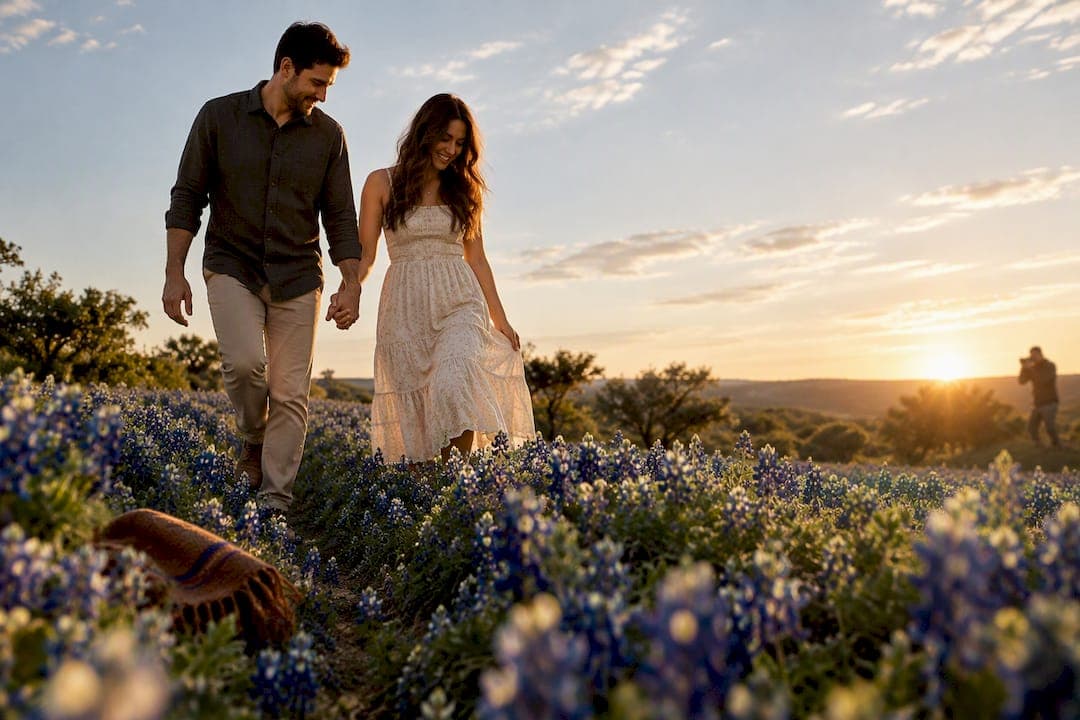
Yes, bluebonnet engagement photos are worth planning around. They're some of the most romantic, distinctly Texan images a couple can get. The catch is that the bloom window is short and unpredictable, so success comes down to three things: timing your session to peak bloom, securing permission on whatever land you use, and scouting with your photographer close to the date rather than months ahead.
TL;DR:
- The success of bluebonnet engagement photos relies heavily on close-to-date scouting and obtaining landowner permission, as bloom conditions vary annually.
- Photographers typically frame from field edges, slopes, or paths and avoid walking into dense patches to protect the flowers and achieve the best composition.
- Planning should include backup fields and timing the session during late March or April's peak bloom, which fluctuates based on weather conditions.
- Wear muted or neutral colors to complement the bluebonnets and avoid bright reds or neons that clash with the floral backdrop.
- Movement prompts and specific pose suggestions, like walking hand-in-hand or lifting attire, create more natural and flattering images in the field.
Table of Contents
- What Do Bluebonnet Engagement Photos Actually Look Like?
- When Do Texas Bluebonnets Actually Bloom?
- Is It Legal to Take Photos in a Bluebonnet Field?
- What Should You Wear for a Bluebonnet Photo Session?
- What Poses Work Best in a Bluebonnet Field?
- How Do You Plan the Logistics of a Bluebonnet Session?
- How a San Antonio Photographer Approaches a Bluebonnet Shoot
- What Most Advice on This Topic Gets Wrong
- Book Your Bluebonnet Engagement Session
- Sources
- FAQ
What Do Bluebonnet Engagement Photos Actually Look Like?
The best sessions mix a handful of shot types rather than repeating the same pose in a different field. A few that consistently deliver:
- Wide landscape shots with the couple small against a rolling field of blue, shot low to the ground so the flowers fill the foreground.
- Close-up detail shots of hands, rings, or a bouquet resting against the petals.
- Walking or movement shots down a trail edge, capturing motion in a dress hem or veil.
- Golden hour silhouettes, where the sun sits low behind the couple and the bluebonnets go soft and dark in the foreground.
- Seated or leaning poses on a blanket at the edge of a dense patch, using foreground blur to suggest more flowers than are actually being sat on.
- Candid laughing shots captured mid conversation rather than posed.
Every one of these works from the edge of a field, not the middle of it. Photographers get the "endless blooms" look by framing from paths or slopes instead of walking into the thickest patch, which also happens to be the least destructive way to shoot. Save a few example images that hit the look you want and send them to your photographer before the session. It saves time on location and gives them a clear target for framing.
When Do Texas Bluebonnets Actually Bloom?
Peak bloom generally runs mid-March through April, but the exact window shifts every year depending on rainfall and temperature. Some springs produce fields so dense they look painted; others are thin and patchy even in the same location.
A few ways to plan around that uncertainty:
- Check a bloom tracker or local trail page in the weeks leading up to your session. Ennis Bluebonnet Trails and Festival publishes bloom updates because even organizers admit density varies year to year.
- Call ahead if you're unsure whether a specific park or roadside patch is open to visitors.
- Keep a backup field or nearby park in mind in case your first choice underwhelms.
Pro Tip: Scout your actual field 3 to 7 days before the shoot, not weeks out. Bluebonnets can go from thin to dense (or get mowed) in less time than that.
Is It Legal to Take Photos in a Bluebonnet Field?
It depends entirely on who owns the land. Roadside strips and some highway right of ways are generally open for quick photos, but plenty of the most photogenic fields are private property. Assuming a field is public because it looks wild is one of the most common mistakes couples make.
Texas A&M AgriLife's guidance is straightforward: check land ownership and get permission before you set up, use designated pull-offs or paths instead of parking on the shoulder, and never drive a vehicle into the field itself.
Safety matters as much as permission once you're there:
- Watch for snakes and fire ants, especially near the base of dense patches where you can't see the ground clearly.
- Stay off narrow roads or appoint someone to watch for traffic if your field sits along a busy route.
- Shoot from the edges of the bloom rather than the center. It protects the flowers for the next family that stops by, and it's usually the better composition anyway.
Respecting the land isn't just courtesy. Trampled bluebonnets don't grow back for that season, and enough damage over a few weekends can wipe out a patch other couples were counting on.
What Should You Wear for a Bluebonnet Photo Session?
Color choice matters more here than in almost any other setting, because that blue is going to dominate the frame. Stick with:
- Neutrals, cream, soft blush, and muted earth tones. They let the flowers do the work instead of competing with your outfit.
- Soft denim, which pairs surprisingly well with the blue-green palette of a bluebonnet field.
- Flowy fabrics like chiffon or light cotton that catch movement in a breeze.
Skip neon colors and bright red. Red in particular tends to clash hard against blue flowers and pulls the eye away from your faces.
Layer for temperature swings, since Texas spring afternoons can start warm and cool off fast once the sun drops. For footwear, sturdy boots or flats work better than heels on uneven field ground. Bring a small blanket for seated shots, a modest bouquet, and skip heavy props that could crush the flowers you're trying to shoot in.

What Poses Work Best in a Bluebonnet Field?
Hand your photographer a short list of shots instead of leaving the whole session to improvisation. A few that reliably photograph well:
- Walking hand in hand down a trail edge, shot from slightly ahead or behind.
- Forehead touch or kiss, framed low so the flowers fill the bottom third.
- Lift and twirl, which creates natural motion in a dress or skirt.
- Back to back, looking over the shoulder, a classic that works even in thinner patches.
- Seated on a blanket, one partner leaning into the other's shoulder.
- Laughing at something off camera, which almost always beats a posed smile.
Movement prompts, like a slow spin or a playful chase step, tend to produce more natural expressions than "stand and smile." For composition, ask your photographer to shoot from a slope or path edge with a wide aperture. It creates the illusion of an endless blue field through foreground blur, without anyone actually standing in the thickest blooms.
How Do You Plan the Logistics of a Bluebonnet Session?
Treat the week before your session as scouting time, not the month before. Fields change fast, and bloom density varies enough between locations that a field that looked perfect three weeks ago might be past its peak by shoot day.
Practical prep that saves the session:
- Have a second field or nearby park ready as backup in case your first choice disappoints.
- Plan around golden hour, and build in extra drive and parking time since good fields often sit off the beaten path.
- Pack water, bug spray, a blanket or towel, comfortable shoes, a small outfit touch-up kit, and basic first aid.
Pro Tip: If your top field looks thin a few days out, ask your photographer about shooting a day earlier or later at a slightly different site. A denser field with slightly less ideal light usually photographs better than a perfect sunset over sparse blooms.
How a San Antonio Photographer Approaches a Bluebonnet Shoot
A solid bluebonnet session starts before the camera comes out. Pre-scouting, a quick style conversation with the couple, and a backup location lined up in advance all happen days ahead, not the morning of. On site, that means checking for hazards, confirming the field is open to shoot on, and deciding in the moment whether density or light matters more for that particular hour.

Sometimes the flowers win. Sometimes the light does. Communicating that tradeoff to the couple beforehand keeps expectations realistic when a session runs slightly earlier or later than planned.
What Most Advice on This Topic Gets Wrong
Most bluebonnet content is a photo dump with captions bolted on. It shows you a hundred pretty pictures and none of the reasoning behind why they work, which leaves couples chasing a look without understanding the mechanics that produce it.
Here's the actual judgment call that matters: density beats perfection. Couples fixate on finding the single most Instagram-famous field, when a decent patch shot well from the right angle at the right hour almost always outperforms a legendary field shot badly in flat light or a picked-over crowd scene. The framing technique, edges and slopes instead of the dead center, matters more than which specific highway pull-off you found on a map.
The other gap in most advice: nobody tells couples that permission and plant damage are real constraints, not fine print. A trampled field doesn't recover in time for the next family's photos that same season. Prioritize a photographer who scouts close to your date, respects the land, and can pivot fast between two or three backup spots. That flexibility matters more than any single "best" location.
— Todd
Book Your Bluebonnet Engagement Session
A reliable photographer handles the part most couples dread: figuring out where the bluebonnets actually look good this week, not last month's forecast. Scouting close to your session date, shooting from field edges instead of the middle of the bloom, and building in a backup location are standard practice, not an upsell. That means fewer wasted trips and a session built around whatever the flowers are actually doing when you show up.
Spring dates fill up fast once bluebonnets start trending on social feeds, and photographer availability during that narrow window disappears even quicker than the blooms do. If you're planning a session this season, check availability and see sample galleries on the engagement session page, or look into wedding photography and videography if you're ready to lock in your big day next.
Sources
- Wildflower photography: a matter of perspective | Texas A&M AgriLife
- Ennis Bluebonnet Trails and Festival — Visit Ennis
FAQ
How Much Should Engagement Photos Cost?
Pricing varies widely by photographer, location, and package inclusions, so there's no single industry standard figure. Larson Pro Photography's current engagement session pricing is available directly on the engagement page rather than listed as a flat rate here.
Is $500 a Lot to Pay for Engagement Photos?
It depends on your market and what's included, such as edited image count, session length, and wardrobe changes. Engagement pricing varies widely, so it's worth comparing what deliverables come with a given price rather than judging the number alone.
Who Usually Pays for Engagement Photos?
The couple typically covers this cost themselves, since engagement sessions are considered separate from wedding day photography. Some couples split it with family contributions toward the wedding budget, but there's no fixed rule.
When Is the Best Time of Day for Bluebonnet Photos?
Golden hour, the hour or so before sunset, gives the softest and most flattering light for bluebonnet sessions. Early morning works too if you want to avoid midday heat and harsh shadows, but afternoon crowds at popular fields tend to thin out by evening.
Do I Need Permission to Shoot in a Bluebonnet Field?
Yes, if the field is on private property, and you should always confirm ownership before setting up. AgriLife's guidance recommends using designated pull-offs or paths and never driving into the field itself.