Your photographer just mentioned "bokeh" and "off-camera flash" in the same breath, and you smiled and nodded while secretly wondering what any of that means. Sound familiar? Most engaged couples in San Antonio walk into their first photography consultation with excitement but leave feeling slightly lost in a sea of technical language. That gap between what your photographer says and what you understand directly shapes the photos you receive on your wedding day. This guide breaks down the most important wedding photography terms, shows you how they apply at real San Antonio venues, and gives you the language to ask better questions and get exactly the photos you've been dreaming about.
Table of Contents
- Demystifying core technical terms
- Posing methodologies: From classic to candid
- Lighting essentials: Making the most of your venue
- Expert insights: Anticipation, prompts, and real moments
- What most couples get wrong about wedding photography jargon
- Ready to capture your San Antonio wedding story?
- Frequently asked questions
Key Takeaways
| Point | Details |
|---|---|
| Core terminology matters | Understanding basic photography terms helps you communicate and get photos you’ll love. |
| Most 'candid' shots are guided | Photographers use prompts to create natural-looking moments—knowing this helps you relax. |
| Lighting shapes your images | Golden hour and venue lighting affect photo quality, so discuss options with your photographer. |
| Anticipation beats reaction | Great photographers plan for emotional moments and use technical tools to capture them beautifully. |
Demystifying core technical terms
Now that we've set out to clarify the jargon, let's break down the most common technical terms you'll encounter when working with a wedding photographer.
Core technical terms in wedding photography include ambient light, aperture, bokeh, and backlighting. Each one sounds intimidating at first, but once you know what they mean, you'll recognize exactly when and why your photographer is using them.
Ambient light is simply the existing light in a space, whether that's sunlight streaming through stained glass at a San Antonio chapel or the warm glow of string lights at a River Walk reception. It's the light that's already there before your photographer adds anything artificial. When a photographer says "I love working with your venue's ambient light," they mean the natural environment is already doing a lot of the heavy lifting.
Aperture refers to the opening inside your camera lens. A wide aperture (expressed as a low f-number like f/1.8) lets in more light and creates a shallow depth of field, meaning only part of the image is sharp while the rest blurs beautifully. A narrow aperture (like f/11) keeps more of the scene in focus. At an outdoor ceremony on a bright San Antonio afternoon, your photographer might use a narrower aperture to keep both you and your partner sharp against the landscape.
Bokeh is that soft, dreamy blur you see in the background of portrait shots. It's a byproduct of shooting with a wide aperture lens. When you see a photo where the couple is sharp and the fairy lights behind them melt into glowing circles, that's bokeh at work. It's not an accident; it's a deliberate creative choice.
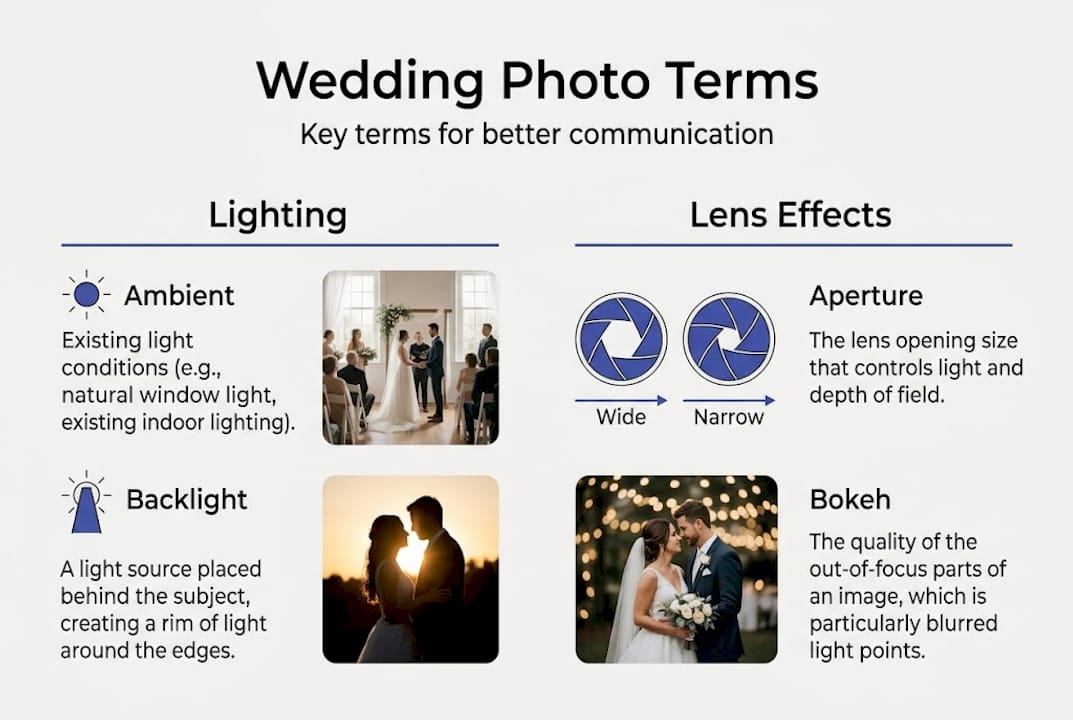
Backlighting means the main light source is behind the subject rather than in front. At golden hour on a Texas ranch, your photographer might position you facing away from the sun so the light wraps around you, creating a warm, glowing outline. It's a stunning effect when done correctly, but it requires skill to expose the faces properly.
| Term | Simple definition | How it affects your photos |
|---|---|---|
| Ambient light | Existing light in the scene | Determines mood and warmth without added equipment |
| Aperture | Lens opening size | Controls light intake and background blur |
| Bokeh | Background blur effect | Adds dreamy, romantic feel to portraits |
| Backlighting | Light source behind subject | Creates glow and silhouette effects |
Knowing these terms helps you have real conversations with your photographer instead of just hoping they read your mind. When you can say "I really love that bokeh look in your gallery," your photographer immediately knows the style you're after.
Pro Tip: Before your consultation, ask your photographer to pull up two or three photos from past San Antonio weddings that show each of these effects. Seeing the visual example alongside the term makes everything click instantly.
- Ambient light matters most during indoor ceremonies with limited windows
- Aperture choices shift throughout the day as lighting conditions change
- Bokeh is most visible in portrait sessions and first-look moments
- Backlighting is most dramatic during golden hour and sunset portraits
Posing methodologies: From classic to candid
With technical basics covered, the next hurdle is how you'll look and feel during your wedding portraits. Let's explore posing styles so you can walk into your shoot knowing exactly what to ask for.
Most couples say they want "natural, candid photos," but very few understand what actually goes into creating them. Here's the truth: 90% of candid photos are actually directed by the photographer using subtle prompts. A truly unscripted photo is rare and often unpredictable in quality. The best photographers work along a posing spectrum, guiding couples toward genuine emotion rather than simply snapping whatever happens.
Think of posing as a dial with five settings. At Level 1, the photographer places you in a specific position, tells you exactly where to look, and clicks the shutter. The result is formal and structured, great for traditional family portraits but often stiff for romantic couple shots. At Level 5, the photographer steps back entirely and documents whatever unfolds, which works beautifully during the ceremony or reception dancing but can feel chaotic for portrait sessions.
Levels 3 and 4 are where the magic happens. At these levels, your photographer gives you a prompt like "walk toward me and tell each other something you're excited about for today" and then captures the genuine laughter, glances, and touches that follow. You're not posed in a rigid sense, but you're not left to figure it out alone either. This is why reviewing wedding photo trends can help you identify which posing style resonates with you before your consultation.
"The couples who get the most natural-looking galleries are the ones who trust the process of directed prompting. We're not manufacturing emotion; we're creating the conditions for real emotion to surface. A well-placed prompt does more for a photo than any technical setting."
| Posing level | Description | Best use case |
|---|---|---|
| Level 1 | Fully directed, specific positions | Formal family portraits |
| Level 2 | Directed with some flexibility | Traditional couple portraits |
| Level 3 | Prompted natural movement | Romantic portrait sessions |
| Level 4 | Prompted genuine moments | Candid-style couple stories |
| Level 5 | Fully unscripted | Ceremony, reception dancing |
Here's how to communicate your preferred posing style clearly:
- Browse the photographer's wedding photography gallery and save five to ten images that feel like "you"
- Note whether those images look more structured or more spontaneous
- Tell your photographer which level on the spectrum feels most comfortable
- Share any activities or moments that bring out your natural dynamic as a couple
- Ask how they handle shy or camera-nervous partners, since a good photographer adjusts their approach accordingly
Reading client posing experiences from past couples can also give you a realistic preview of what working with a specific photographer actually feels like on the day.
Lighting essentials: Making the most of your venue
How you and your guests are posed is only part of the story. How your event is lit makes a dramatic difference in every photo, and San Antonio's mix of historic churches, outdoor ranches, and urban venues creates some genuinely unique lighting challenges.
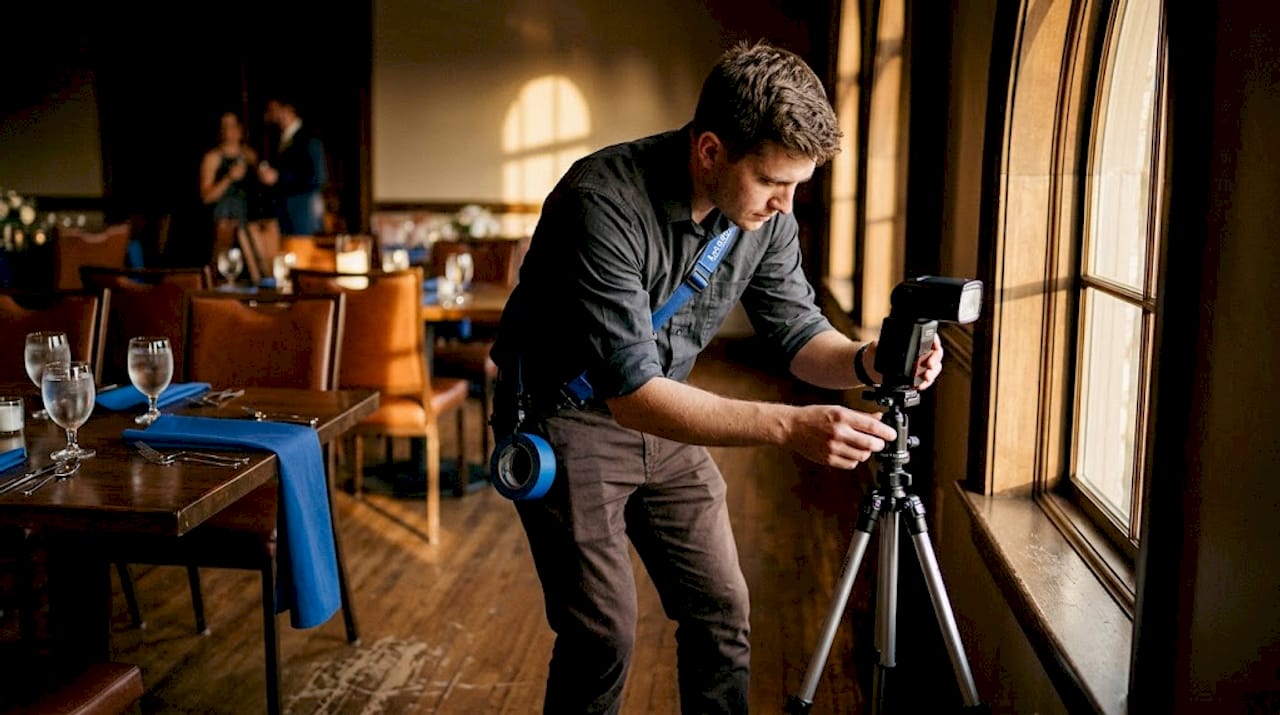
Off-camera flash means the photographer's flash unit is not attached to the camera. Instead, it's positioned separately, often on a stand or held by an assistant, to create directional, sculpted light. This gives the photographer far more control than a flat, on-camera flash that simply blasts light straight at the subject. At a dimly lit reception hall in downtown San Antonio, off-camera flash is often what separates a professional result from a snapshot.
Golden hour is the 20 to 30 minutes before sunset when the sun sits low on the horizon and casts warm, soft, directional light across everything.
are rated the most beautiful by 67% of photographers, and for good reason. The light is flattering, the color tones are rich, and the whole scene feels cinematic. If your venue and timeline allow it, scheduling a short portrait session during golden hour is almost always worth it.High ISO refers to the camera sensor's sensitivity to light. In dark environments like a candlelit chapel or a dimly lit ballroom, your photographer raises the ISO to capture more light without needing a slow shutter speed or a flash. The tradeoff is that very high ISO settings can introduce "grain" or "noise" into the image, though modern cameras handle this remarkably well.
When you tour potential venues, here are questions worth asking about lighting:
- Does the venue allow flash photography during the ceremony?
- Are there large windows that let in natural light, and which direction do they face?
- What time does the ceremony end relative to sunset?
- Are there any restrictions on additional lighting equipment at the reception?
- Does the venue have warm or cool-toned artificial lighting?
Pro Tip: Talk to your photographer about your venue's lighting conditions before the wedding day, not on it. Ask them specifically how they'll adapt if the weather changes or if the timeline shifts and you lose your golden hour window. A prepared photographer will already have a backup plan.
Checking out wedding venue lighting insights from photographers who have worked in San Antonio venues can help you spot potential challenges early and plan around them.
Expert insights: Anticipation, prompts, and real moments
But how do all these terms and techniques actually come together for emotional, memorable photos? Here's what the best photographers do differently.
The most important skill a wedding photographer has is not technical at all. It's anticipation over reaction. Amateur photographers wait for moments to happen and then try to capture them. Expert photographers read the room, position themselves in advance, and are already pressing the shutter as the moment begins to unfold. During a San Antonio ceremony, that might mean watching the groom's face as the bride appears at the top of the aisle rather than pointing the camera at the bride herself.
Directed prompts are the practical tool that makes this possible during portrait sessions. A prompt isn't a pose instruction. It's more like a conversation starter or a small task. "Whisper your favorite thing about today into their ear." "Walk me through what your morning looked like." "Show me how you hold hands when you're watching a movie." These simple directions produce genuine reactions because the couple is focused on each other, not on the camera.
High ISO capability matters here too. When a photographer can shoot at ISO 3200 or higher without sacrificing image quality, they can work in low-light environments without using flash, which would disrupt the moment entirely. This means capturing the quiet exchange between a father and daughter before the walk down the aisle, or the tears during a candlelit vow reading, without anyone noticing the camera is even there.
"My job is to be invisible and omnipresent at the same time. I want to be everywhere important is happening, but I never want anyone to feel like they're being photographed. That balance comes from reading people, anticipating emotion, and being technically ready for whatever the light throws at me."
Here's how you as a couple can actively help create real, unguarded moments:
- Focus on each other during portrait sessions, not on the camera
- Share a genuine secret, joke, or memory when the photographer gives a prompt
- Let yourself feel the day rather than performing for photos
- Trust that your photographer's positioning and timing are intentional
- Avoid checking your phones between shots, since it breaks the emotional flow
Exploring photographer expertise and understanding how experienced photographers approach their craft gives you a much clearer picture of what to look for when choosing your team.
What most couples get wrong about wedding photography jargon
Here's the honest truth after working with couples across San Antonio: most of them learn the terminology after the wedding, not before. They'll look at their gallery and say "I wish we had more of that soft background blur" or "I didn't realize we could have asked for more golden hour time." The knowledge was available; they just didn't know to ask.
The biggest misconception is that learning photography terms is the photographer's job, not yours. But terminology is a shared language. When you know what bokeh means, you can ask for it. When you understand the posing spectrum, you can tell your photographer where you fall on it. That single shift in communication changes the entire dynamic of your shoot.
You don't need to become a photography expert. You need to know enough to have a real conversation. Honestly, knowing just five or six terms puts you ahead of 80% of couples walking into consultations. It signals to your photographer that you're engaged, intentional, and worth investing creative energy in.
Staying current on wedding trends couples miss is one way to keep that conversation fresh and relevant. The couples who get the most out of their photography experience are the ones who treat their photographer as a creative partner, not just a vendor.
Pro Tip: Before your engagement session, practice using three or four of these terms in conversation with your photographer. It's a low-stakes environment to build rapport and test how well you communicate before the wedding day itself.
Ready to capture your San Antonio wedding story?
Now that you can speak your photographer's language, make the most of it by choosing a team who values clear communication just as much as technical skill.
Couples who understand photography terminology don't just get better photos. They get a better experience from the first consultation through the final gallery delivery. At Larson Pro Photography, we work with San Antonio couples who want to be genuine partners in the creative process. Explore our San Antonio wedding photography portfolio to see how these techniques translate into real wedding stories, and take a look at our engagement session options to practice your communication and comfort in front of the camera before the big day. We'd love to hear what you're envisioning.
Frequently asked questions
What does 'aperture' mean in wedding photos?
Aperture is the lens opening that controls how much light enters the camera and how much of the image appears sharp or beautifully blurred, directly shaping the mood of your portraits.
How can we get more natural-looking wedding photos?
Ask your photographer to use directed prompts for candid-feeling poses, since nearly all natural-looking photos are gently guided rather than fully unscripted.
Why is golden hour recommended for wedding portraits?
Golden hour light is warm, soft, and rated the most beautiful by 67% of photographers, making it the most flattering and cinematic window for outdoor portraits.
What can couples do if their ceremony venue is very dark or doesn't allow flash?
Expert photographers use high ISO and silent shutter techniques combined with strategic positioning to capture sharp, emotional images in low light without disrupting the ceremony.